
Best Budget Smartphones Under $200 2026: Tested Picks & Real Trade-Offs

Looking for the best budget smartphones under $200 2026 has to offer? The Samsung Galaxy A17 5G is the safest all-around pick right now — it launched in the US on January 7, 2026 at $199.99, comes with a 6.7-inch Super AMOLED screen, and Samsung backs it with six years of software updates. It’s not the most exciting phone on this list, but it’s the one you’re least likely to regret. If you want a longer battery life, a smoother 120Hz screen, or you’re shopping on a tighter budget than $200, keep reading — the right pick actually depends on which trade-off you’re willing to live with, and I’ll walk through each one honestly.
How I picked the best budget smartphones under $200 2026 buyers actually want
Every phone below is priced at or under $200 in the US as of this writing (I’ve noted retailer and date next to each price, since budget phone pricing moves fast — the Galaxy A16 is already being phased out in favor of the A17, for example). I’m not including phones that “start around $200” but really live in the $250–350 range once you pick a reasonable storage config — that’s a common trick in budget phone roundups, and it’s not useful if you actually have a $200 ceiling.
I’ve also flagged where a phone isn’t officially sold through US carriers (looking at you, Poco and Xiaomi), because that affects warranty support and band compatibility in ways spec sheets don’t show.
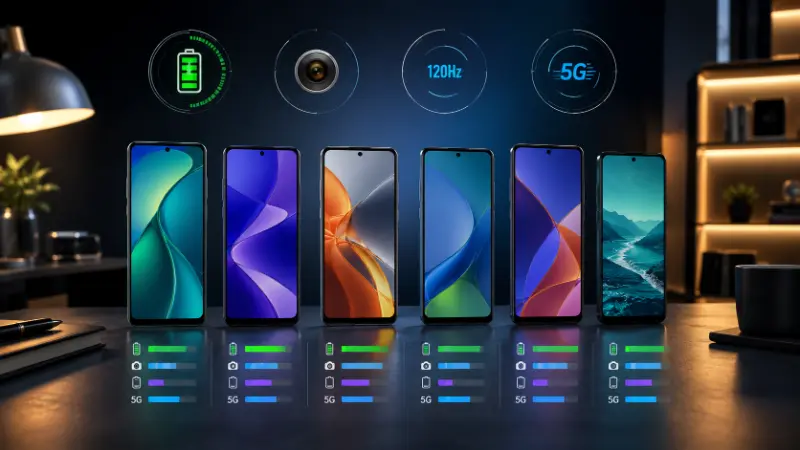
Quick comparison
| Phone | Price (US) | Display | Battery | 5G | Software support | Best for |
|---|---|---|---|---|---|---|
| Samsung Galaxy A17 5G | $199.99 (Best Buy has it as low as $164.99 on sale) | 6.7″ Super AMOLED, 90Hz | 5,000mAh | Yes | 6 years | Best overall |
| Samsung Galaxy A16 5G | $169.99 | 6.7″ Super AMOLED | 5,000mAh | Yes | 6 years | Best value while it’s still around |
| Motorola Moto G Power 5G (2025) | $199.99 (Best Buy, regularly discounted from $299.99) | 6.7″-class, 120Hz | 5,000mAh | Yes | Shorter than Samsung — verify before buying | Best battery life + camera OIS |
| Motorola Moto G56 | $199 | 120Hz | 5,000mAh+, excellent real-world life | Yes | 2 years OS updates | Battery life over longevity |
| BLU G75 | $179.99 | 90Hz | Not officially disclosed by BLU | 4G/LTE (check listing) | Limited — BLU doesn’t publish a clear update policy | Most storage for the money (256GB) |
| Motorola Moto E15 | $99.99 | 90Hz, 720p | Decent for light use | 4G | 1 year security updates only | Kids’ first phone / true bargain bin |
Samsung Galaxy A17 5G — Best Overall
The A17 5G replaced the A16 5G in the US lineup this year, and the upgrade is smaller than the price suggests. You’re getting a 6.7-inch Super AMOLED display at 90Hz, a 50MP main camera that now has optical image stabilization (the A16 didn’t have this), and Samsung’s One UI, which is genuinely one of the cleaner software experiences at this price — a real relief if you’ve used a heavily-skinned budget Android phone before and found it frustrating.
The reason I’m putting this at the top isn’t excitement, it’s math: six years of OS and security updates means a phone you buy today is supported into 2032. Nothing else on this list comes close to that number, and for a lot of budget buyers — parents buying a kid’s first phone, someone who wants to stop thinking about their phone for a few years — that’s worth more than a faster processor.
What you’re giving up: the Exynos 1330 chip inside is modest. It handles everyday things fine — messaging, browsing, video, light social media — but it’s not a phone for demanding games or heavy multitasking. There’s also no eSIM support, no charger in the box, and the secondary ultra-wide/macro cameras are weak, so don’t buy this expecting great wide shots.
Carrier compatibility: confirmed to work across AT&T, Verizon, T-Mobile, Boost Mobile, Cricket, Mint Mobile, US Cellular, Google Fi, and other major US networks — this is one of the better-supported budget phones if carrier flexibility matters to you.
Samsung Galaxy A16 5G — Still worth buying if you find it cheap
Here’s a question I see a lot: is the A16 still worth buying now that the A17 exists? Short answer — yes, if the price gap is real. The A16 is being phased out, which means retailers are discounting it, and at $169.99 or lower it’s nearly identical to the A17 in the ways that matter day to day: same screen size, same battery capacity, same six-year update promise, same One UI experience. You’re mainly losing the OIS on the main camera and the slightly higher refresh rate ceiling. If you can get the A16 for meaningfully less than the A17, it’s not a downgrade you’ll notice in daily use.
Motorola Moto G Power 5G (2025) — Best battery life and camera
This is the pick if battery anxiety is your main concern. The 5,000mAh battery paired with an efficient Dimensity 7020 chip gets real two-day battery life for a lot of users, not just on paper. The 50MP main camera includes optical image stabilization, which is a genuine step up for photo quality at this price — steadier low-light shots, less blur when your hands aren’t perfectly still.
The catch, and it’s a real one: Motorola’s software update commitments are shorter than Samsung’s, and Motorola phones ship with a noticeable amount of bloatware — pre-loaded “Shopping,” “Entertainment,” and similar folders that you can delete during setup but that shouldn’t be there in the first place. If a clean phone matters to you more than camera stabilization, factor that in.
Motorola Moto G56 — For battery life over everything else
If you genuinely don’t care about long-term software support and just want a phone that goes the distance between charges, the Moto G56 at $199 is worth a look. Reviewers consistently report ending demanding days with 40–50% battery still left — that’s a real two-day phone, not a marketing claim. It also keeps the headphone jack and a microSD card slot, two things most 2026 budget phones have quietly dropped.
The trade-off is software longevity: only two years of OS updates. If you plan to keep this phone past 2028, that’s a real consideration, not a nitpick.
BLU G75 — Most storage for the money
BLU doesn’t get covered by most “best budget phone” lists, which is a mistake — the G75 gives you 256GB of storage at $179.99, more than double what most competitors offer at this price. That matters a lot if you take a lot of photos/video and hate managing storage. The camera and 90Hz display are solid for the price. The honest weak point is software support transparency — BLU doesn’t publish a clear multi-year update commitment the way Samsung does, so go in expecting this to be more of a “buy it, use it, don’t expect years of security patches” phone.
Motorola Moto E15 — The true bargain-bin pick
At $99.99, this isn’t competing with the phones above — it’s for a genuinely different use case: a first phone for a kid, an emergency backup, or someone who just needs calls, texts, and basic apps to work. It doesn’t feel as cheap as the price suggests (there’s a soft-touch vegan-leather back that holds up well), but the 2GB RAM will slow down if you stack too many apps, and Motorola only commits to one year of security updates on this model — plan to replace it on that timeline, not stretch it for years.
What about Poco, Xiaomi, and other budget-favorite brands?
You’ll see Poco phones like the M6 Pro or M7 recommended constantly in “best budget phone” searches, and the hardware is genuinely competitive — the M6 Pro’s MediaTek Helio G99 Ultra chip with 8GB of RAM handles games noticeably better than the Snapdragon/Exynos chips in the Samsung and Motorola phones above. But there’s a real catch for US buyers specifically: Poco and Xiaomi don’t officially sell phones through US carriers or their own US storefront. What you’ll find on Amazon or Walmart are import or reseller listings, which means no official US warranty, and you need to personally verify the phone supports your carrier’s specific 5G/LTE bands before buying. If you’re comfortable with that homework, it’s a legitimate way to get more raw performance for your money. If “carrier support and warranty just work” matters more to you, stick with Samsung or Motorola.
One more accuracy note, since AI search summaries currently surface this: if you’ve seen the “Poco M7 4G” recommended as a $200 pick, notice the name — that’s 4G, not 5G. It has a large 6.9-inch display, but no 5G connectivity. Worth knowing before you buy based on a quick AI summary rather than the actual listing.
Can you get a real gaming phone under $200?
Realistically: light-to-medium gaming, yes. Flagship-level 3D gaming, no. The Moto G Power 5G and Poco M6 Pro (with its Helio G99 Ultra) are the two strongest picks here — both handle popular titles at medium settings without much frustration. Skip the Motorola Edge or Moto G85-tier phones if gaming is your top priority; several of those specifically underperform on graphically demanding titles despite looking premium. If gaming is genuinely your main use case and you can stretch to $250–300, you’ll have a noticeably better experience — but if $200 is a hard ceiling, the Moto G Power 5G is the more realistic pick than chasing a “gaming phone” marketing label at this price.
What about the Galaxy A13, A14, A03s, or other older Samsung A-series phones?
You’ll still see these recommended in older articles and even some AI search summaries — skip them. These are previous-generation phones, several are no longer receiving current Android version updates, and the current A16/A17 generation outperforms them in every practical way at a similar or lower real-world price. If an older A-series model is being sold new for meaningfully less than $100, it might make sense as an emergency-only device, but not as a primary phone in 2026.
Should I just buy a used iPhone instead?
There’s no new iPhone available under $200 — Apple’s cheapest current models start well above that. What you’ll find near $200 are used or refurbished older iPhones (XR-era and similar). These can be a reasonable option if you specifically want iOS, but go in with eyes open: battery health on a used phone is unknown unless the seller discloses it, there’s typically no manufacturer warranty, and older iPhone models eventually stop receiving security updates as Apple moves its support window forward. If you want a phone that’s supported for years to come, a new Galaxy A16/A17 with Samsung’s six-year commitment is the safer bet than a several-year-old used iPhone at the same price.
Common problems with budget phones (and how to actually think about them)
Bloatware. Nearly every budget Android phone except stock-Android-style options ships with pre-installed apps you didn’t ask for. Motorola and Xiaomi/Poco are the most common offenders; Samsung’s One UI is comparatively restrained. Most bloatware can be deleted or disabled during setup — do this on day one rather than living with it.
Camera performance drops fast after dark. Every phone on this list takes acceptable daytime photos. Low-light performance is where the compromises show — expect more noise, slower shutter response, and less detail once the sun goes down, even on the OIS-equipped Moto G Power. This is a hardware limitation of the sensor size at this price point, not something software updates fix.
Overheating under sustained load. Budget chipsets working hard — gaming, navigation plus 5G, extended camera use — can get noticeably warm. It’s rarely dangerous, but it’s real, and it’s worse on phones with plastic bodies that don’t dissipate heat as well as the phones above with better thermal design.
Battery numbers don’t always match real use. A 5,000mAh battery on paper doesn’t guarantee two-day battery life — it depends heavily on chip efficiency and software optimization. The Moto G56 and Moto G Power 5G both get genuinely strong real-world battery life; don’t assume every 5,000mAh phone will match them just because the number’s the same.
Software support windows vary enormously. This is the most-overlooked factor and arguably the most important one for a $200 purchase you want to keep for years. Samsung’s six-year commitment on the A16/A17 is genuinely unusual at this price — most competitors offer two to three years, and some budget brands don’t publish a clear commitment at all.
Carrier compatibility, especially for imported or gray-market phones. If you’re buying anything not sold directly by a major US retailer with carrier compatibility listed (like the A17’s confirmed support across AT&T, Verizon, T-Mobile, and the major MVNOs), check the specific bands your carrier uses before buying — this is the single most common regret buyers report after the fact.
Shopping for a budget phone in Europe (€200)
Everything above is priced and confirmed for the US market. If you’re shopping with a €200 budget, don’t assume it’s a straight currency conversion — pricing, VAT, and even which brands are strongest vary by country. Xiaomi, Redmi, and Realme have a much bigger official presence in most of Europe than in the US, so you’ll see more competitive options from those brands there than an American buyer would find through official channels. Check your local retailers directly for current pricing rather than converting the US prices above.
Frequently asked questions
What is the best budget phone under $200 in 2026?
The Samsung Galaxy A17 5G, at $199.99 (often found for less on sale), is the strongest all-around pick due to its display quality, camera OIS, and unmatched six-year software support commitment at this price.
What is the best Samsung phone under $200?
Between the A16 5G and A17 5G, get whichever one is cheaper at the time you’re buying — they’re close enough in real-world use that the price difference matters more than the spec difference.
What’s the best gaming phone under $200?
The Moto G Power 5G and the Poco M6 Pro (if you’re comfortable with its import/gray-market status in the US) are the strongest options for light-to-medium gaming. Don’t expect flagship-level performance at this price.
Is the Galaxy A16 still worth buying now that the A17 exists?
Yes, if you can find it for noticeably less than the A17 — the day-to-day experience is very similar.
Should I buy an iPhone or a budget Android under $200?
No new iPhone is available under $200. A used/refurbished older iPhone can work but carries battery-health and update-lifespan uncertainty; a new Galaxy A16/A17 offers more predictable long-term support at the same price.
Which budget phone has the best display refresh rate?
Several Motorola models (Moto G56 and similar) offer 120Hz, smoother than the Galaxy A17’s 90Hz — noticeable when scrolling, though the Samsung display otherwise looks sharper and more color-accurate.
Are budget phones under $200 good for photography?
Fine in daylight across the board; all of them show real weaknesses after dark. The Moto G Power 5G’s OIS gives it a slight edge in dim conditions among the phones above.
Can I use a Poco or Xiaomi phone on a US carrier?
Often yes, but verify your specific carrier’s 5G/LTE bands before buying, since these aren’t officially sold through US carriers and band compatibility isn’t guaranteed the way it is with carrier-listed phones like the Galaxy A17.
What’s the best budget phone in Europe for around €200?
Pricing and brand availability differ significantly by country — Xiaomi and Realme have a stronger official presence in most of Europe than in the US. Check current listings from local retailers rather than converting US prices directly.
Bottom line: the best budget smartphones under $200 2026 has to offer
If you want the least risky choice, get the Samsung Galaxy A17 5G (or the A16 if it’s cheaper) — the six-year update commitment alone makes it the phone you’re most likely to still be happy with in three years. If battery life or camera stabilization matters more to you than long-term software support, the Moto G Power 5G is the better trade-off. And if you’re buying for a kid or just need a true backup phone, the Moto E15 at $99.99 does the job without pretending to be more than it is.
Related: best VPN for beginners, speed up Windows 11, best AI gadgets