
Best AI Gadgets 2026: What’s Actually Worth Buying (And What to Skip)

If you’re asking whether AI gadgets are worth buying in 2026, start with one question before you spend anything: can your phone already do this? For most of the “AI gadget” category, the honest answer is yes. The ones worth your money are the small number that do one specific job better than a phone can — hands-free capture, ambient note-taking, or health tracking without a screen in your face.
We tested against that filter, not against marketing copy. Here’s what earned a spot, what to skip, and the pain points nobody puts in the product description.
The AI Gadget Graveyard You Should Know Before You Buy Anything
Before the recommendations, some history that most “best AI gadgets” posts skip, and it matters. In 2024, the Humane AI Pin and Rabbit R1 both promised to replace your phone. Neither did. The Humane AI Pin was discontinued on February 28, 2025, when HP acquired the company’s IP for a reported 116 million dollars and shut the cloud service down entirely. A used Pin today is a paperweight — the AI features it was sold to perform no longer function. The Rabbit R1 is still alive as of August 2026, still shipping, still getting firmware updates, but it never delivered the “agent that runs your apps for you” pitch from launch, and industry write-ups now use it as the textbook example of novelty outrunning usefulness.
Why this matters for your buying decision: the pattern that killed those two products — a gadget trying to replace your phone instead of extending it — is still the single biggest predictor of an AI gadget you’ll return within a month. Every recommendation below passes that test.
Best AI Gadgets Overall in 2026
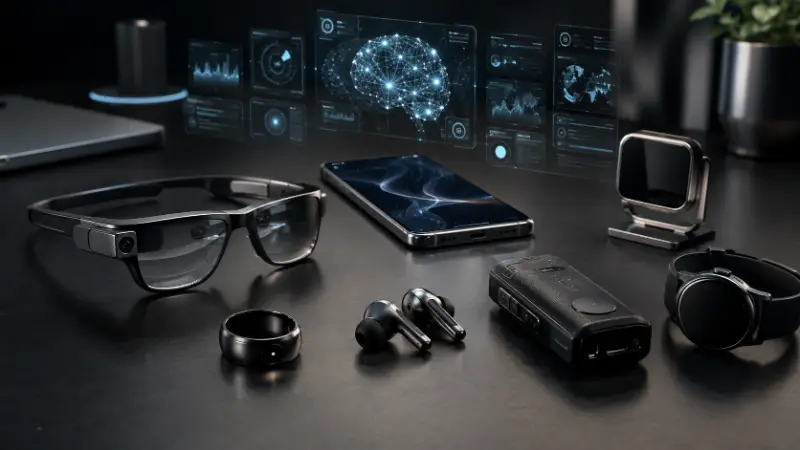
The category has matured past the “AI pin” phase into three real use cases: capture (glasses), ambient notes (pendants and pin recorders), and biometrics (rings and bands).
The strongest all-rounder for most people right now is the Ray-Ban Meta Gen 2 — it runs Meta AI on Llama 4, does live translation in six languages, shoots 3K video, and gets 8 hours of battery with the case adding another 48. It’s also not a niche pick: Meta held roughly 82% of global smart-glasses shipments in the second half of 2025, and the wider glasses category grew 139% year over year, according to Counterpoint Research. Analysts at Smart Analytics Global project the AI-glasses market to roughly quadruple in 2026, from about 6 million units and 1.2 billion dollars in 2025 to 20 million units and 5.6 billion dollars this year. This isn’t a hype product — it’s where the actual purchase volume is going.
For meeting-heavy work, the strongest pick is the Plaud Note Pro. If your calendar is wall-to-wall calls, this is worth the price on its own.
Best AI Wearables 2026
AI wearables split into three jobs, and mixing them up is the most common reason people return them.
Ambient Recorders and Pendants
The Limitless Pendant records surrounding audio and turns it into searchable notes, with a consent chime so people around you know it’s active. The Bee AI Pendant does similar always-on capture at a lower price point and is now an Amazon-owned product following Amazon’s July 2025 acquisition of Bee.
Biometric Wearables
This is where the subscription question actually matters. Google’s Fitbit Air (99 dollars) is a screenless tracker with a 7-day battery that covers heart rate, sleep, SpO2, and AFib alerts, with no subscription required for core features, and it pairs with the newer Google Health app on both Android and iOS.
The RingConn Gen 2 Air (199 dollars) is the smart-ring version of the same pitch — 10-day battery, sleep and blood oxygen tracking, waterproof, no monthly fee.
Compare that against Oura, where the membership runs 5.99 dollars a month in the US — and if you’re outside the US, check local pricing before buying, because subscriptions scale by region and Oura’s own pricing runs 7.99 CAD in Canada and 9.99 AUD in Australia. Over a three-year ring lifespan that gap is real money, which is part of why a no-subscription ring is the smarter long-term buy if you’re not in the US.
Mood and Journaling Wearables
Nirva, which took Tom’s Guide’s Best AI Wearable award at CES 2026, is a jewelry-style device with dual microphones and a motion sensor that auto-journals your day and tracks emotional patterns through its companion app, including flagging which interactions tend to drain you.
Best AI Smart Glasses 2026
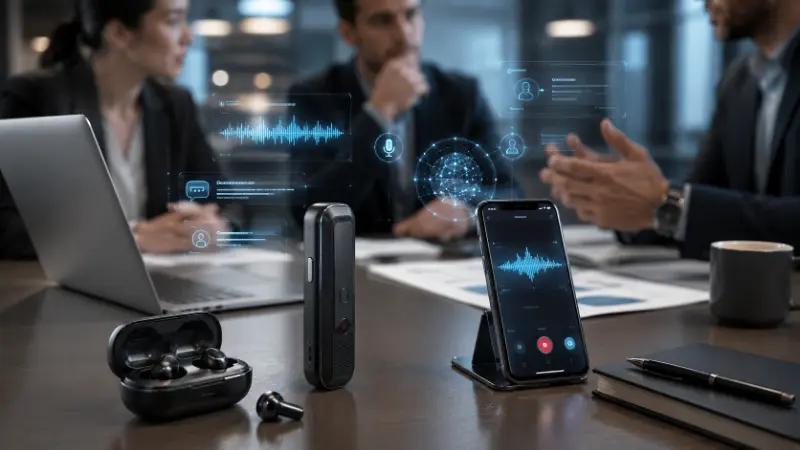
Glasses are the fastest-growing category in AI hardware this year, and also the one with the widest gap between marketing photos and real-world battery life, so check specs against actual use, not the “up to” number on the box.
The Ray-Ban Meta Gen 2 remains the default recommendation — normal-looking frames, no one clocks you as wearing tech, and the 8-hour battery is a real jump from Gen 1.
For fitness specifically, the Oakley Meta Vanguard pairs with a Garmin watch to call out real-time stats mid-run and auto-builds a highlight reel from its 3K camera.
If you want a heads-up display rather than a camera-first device, the Xreal 1S took Tom’s Guide’s Best Smart Glasses award at CES 2026 and leans toward glanceable information over recording.
What to Check Before Buying Smart Glasses
- Whether the camera has a physical shutter or only a software indicator light
- Real battery life for a full day of actual use, not the marketing number
- Whether translation and AI features need an active phone connection to function
Best AI Gadgets Under $100
Under 100 dollars is where “AI” gets stretched thin — a lot of listings are ordinary Bluetooth hardware with a chatbot bolted on for the description. The Google Fitbit Air at 99 dollars is the clearest exception: real biometric tracking, no subscription, backed by an actual health app ecosystem.
Below that price point, be skeptical of anything promising “AI companion” or “real-time AI translation” as a headline feature — the hardware at that cost usually can’t run meaningful processing, so you’re paying for a thin wrapper around something your phone’s built-in assistant already does for free.
Best AI Gadgets Under $200
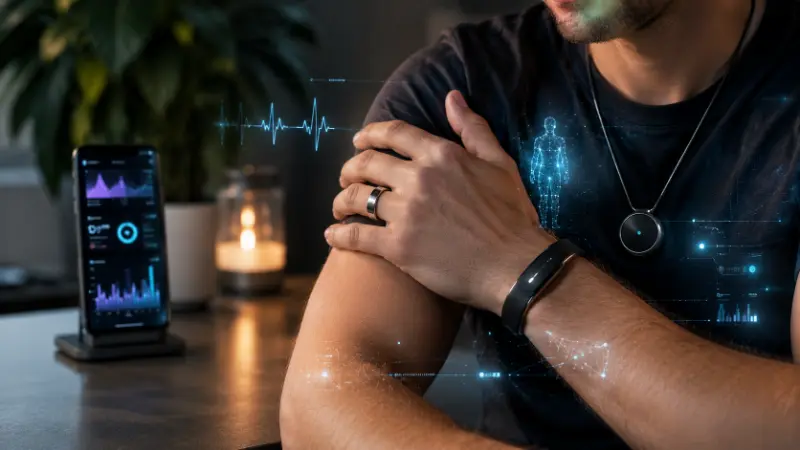
This is the real sweet spot in 2026 — enough budget for genuine on-device processing without flagship pricing.
- The RingConn Gen 2 Air (199 dollars) leads for health tracking with no ongoing fee.
- The Rabbit R1 (199 dollars) is worth naming here too, with a caveat: it’s not dead, it’s still shipping and updating as of August 2026, but buy it for the no-subscription “dedicated AI object” appeal, not because it does anything your phone can’t already do better.
- RecDot’s AI earbuds turn conversations into transcripts and action items across 78 languages and sit in this price range as well.
Best AI Productivity Gadgets
For work use, prioritize gadgets that remove a task you repeat daily, not weekly.
- AI voice recorders and pin-style devices like the Plaud Note Pro handle automatic transcription and summaries for people whose calendar is full of calls.
- AI-capable earbuds handle live translation for international calls without any new hardware to carry.
- Smart-home AI hubs only pay off once you have enough connected devices that voice control actually saves time — for a single smart bulb, it’s not a productivity gadget, it’s a worse light switch.
A Regional Pricing Pain Point Most Guides Skip
If you’re outside the US, two things will bite you that most “best AI gadgets” roundups don’t mention.
First, subscription pricing scales by region, not just currency — see the Oura example above. Second, launches are almost always US-first, and new AI gadgets routinely reach American buyers months before Canada or Australia get official availability, which is exactly when grey-market importers show up with marked-up “imports.” Freight-forwarding to a US address is the common workaround people use, but it adds cost and complicates warranty claims, so factor that in before ordering something that hasn’t officially launched in your country yet.
Buying on Amazon: What to Check Before You Click “Buy”

Amazon’s AI gadget listings move fast and are flooded with near-identical white-label products riding the “AI” keyword. Before buying:
- Check whether “AI” only appears in the title — open the full listing and see whether the AI feature is on-device processing and personalization, or just a generic Bluetooth product with a branded app.
- Read the Q&A section, not just the star rating — return-reason patterns show up there before they drag the rating down.
- Confirm the return window length. Given how common returns are for camera-based wearables specifically, a 30-day window is worth paying slightly more for over a 14-day one.
The Pain Points That Actually Decide Whether You’ll Return It
The subscription trap — a low sticker price often hides a required app subscription to unlock the AI features that made you want the device. Calculate the two-year cost before comparing on price alone.
The “does my phone already do this” test — before buying anything marketed as an AI translator, AI recorder, or AI assistant device, open your phone’s existing assistant and try the same task. In the large majority of cases, it already handles it.
Bystander consent — camera glasses and ambient recorders capture other people, not just you. Recording-consent rules vary by state and country, and it’s increasingly a workplace policy question, not just a personal one. Devices with a hardware camera shutter or a visible recording indicator, like the Limitless Pendant’s consent chime, reduce this friction but don’t eliminate it.
Company survival risk — the Humane and Rabbit stories are the extreme version of this, but it applies to any small AI-hardware startup: if the core feature depends on a cloud subscription from a company with a short track record, budget for the real possibility that service disappears within a couple of years and the hardware becomes e-waste.
Frequently Asked Questions
What is the best AI gadget in 2026?
For daily use, the Ray-Ban Meta Gen 2 smart glasses. For home cleaning, the Roborock Saros 10R. Both succeed because they do one job well instead of trying to replace your phone.
Are AI gadgets worth buying in 2026?
Yes, if the gadget does one specific job your phone genuinely doesn’t cover well — hands-free capture, dedicated health tracking, or ambient note-taking. They’re not worth it when the “AI feature” duplicates something your phone’s built-in assistant already does.
Are AI smart glasses worth buying in 2026?
For most people, yes, provided you check real battery life and whether the camera has a hardware shutter. Smart glasses are the fastest-growing AI hardware category in 2026, with the market projected to roughly quadruple this year, but fit and privacy comfort — not the technology itself — are what drive returns.
Is the Rabbit R1 still worth buying?
It’s not dead — as of August 2026 it’s still shipping with active firmware updates — but it never delivered the full agent experience from its 2024 launch. Buy it for the no-subscription “dedicated AI object” appeal, not as a phone replacement.
What happened to the Humane AI Pin?
It was discontinued on February 28, 2025, when HP acquired Humane’s IP and shut down the cloud service the device depended on. A Humane AI Pin bought secondhand today cannot perform its original AI features.
What’s the best AI gadget under $100?
The Google Fitbit Air at 99 dollars — real biometric tracking with no subscription required for core features. Be cautious of anything under $100 marketed as an “AI companion” or “AI translator,” since the hardware at that price rarely supports real on-device processing.
What’s the best AI gadget under $200?
The RingConn Gen 2 Air at 199 dollars for health tracking with zero ongoing fees, and RecDot’s AI earbuds for meeting transcription in the same price range.
Do AI wearables require a subscription?
Some do, some don’t, and it varies by device and even by region. The Fitbit Air and RingConn Gen 2 Air work without one. Oura requires a membership, and that membership’s price differs by country — confirm the actual figure for where you live before buying, not the US number quoted in most reviews.