
Best Budget Earbuds in 2026: The Complete Guide (ANC, Battery, Bass, Calls, Fit and More)

If you’ve searched anything like “best budget earbuds” recently, you’ve probably noticed the results are a mess. Half the guides are five products deep and stop. The other half read like they were written by someone who’s never actually had a pair fall out mid-run. And buried in the middle of every one of them is the same unanswered question: which pair actually fits YOUR situation — your ears, your commute, your calls, your workouts — not just “budget” in general.
That’s what this guide is for. Fifteen real buying decisions, one page, no filler.
A quick note on how this was put together: picks below are cross-referenced against manufacturer spec sheets and independent testing data from labs that publish their methodology (SoundGuys, RTINGS, Tom’s Guide, TechRadar), plus real owner feedback pulled from Reddit threads and forums, not just press releases. Where a specific number (battery hours, IP rating, Bluetooth version) is stated, it’s sourced from a spec sheet or a lab test, not a guess. Where something is a general impression rather than a hard number, it’s phrased that way.
What “budget” actually covers in 2026
Here’s something most guides skip: “budget earbuds” isn’t one shopper, it’s at least two.
Entry-level earbuds in the $20–$50 range hold roughly 40% of the market by unit volume, and mid-tier models between $50 and $150 hold another 40%. That’s a wide spread, and the people buying at $25 and the people buying at $120 want genuinely different things. If you’re at the bottom of that range, you’re mostly asking “will this survive daily use and not embarrass me on a call.” If you’re near the top, you’re cross-shopping against $250 flagships and asking “what am I actually giving up.”
Both are covered here. Each section below tells you which tier to look in and why.
Best budget earbuds with ANC

Active noise cancellation used to be a $200+ feature. It isn’t anymore — hybrid and adaptive ANC has pushed down into the $25–$80 range, and the difference between budget and flagship ANC is now narrower than most people expect, though it hasn’t disappeared.
The CMF by Nothing Buds 2A are a strong pick here: independent testing shows they handle sustained low-frequency noise (engine drone, HVAC hum, bus and train noise) well for the price, with adaptive ANC that adjusts strength to your environment instead of running one fixed setting. The Sony WF-C710N is the other standout — Sony carried tuning down from its flagship WF-1000X line, and reviewers specifically note the extra microphone Sony added versus the previous model pulls more low-frequency rumble out of the mix.
If you want something even cheaper with real (not marketing-fluff) ANC, the JLab Go Pods ANC is the name that comes up repeatedly as the cheapest pair with genuinely usable noise cancellation — it won’t go as deep as the CMF or Sony picks, but it takes the edge off office noise and subway rumble at a price where losing the earbuds isn’t a disaster.
One thing that trips people up: ANC performance depends almost entirely on ear tip seal. A great ANC chip paired with a loose-fitting tip will underperform a mediocre chip with a perfect seal, because ANC works by canceling the noise that actually reaches your eardrum — if noise is leaking around a bad seal, there’s nothing for the ANC to cancel. Try every tip size in the box before deciding the ANC “doesn’t work.”
Best budget earbuds with transparency mode
Transparency mode (also called ambient mode or hear-through) lets outside sound in without pulling your earbuds out — useful for ordering coffee, hearing traffic, or having a quick conversation without breaking your listening session.
The CMF Buds 2A again perform well here, with reviewers noting transparency mode stays clear during actual conversations rather than producing the muffled, “underwater” effect that gives cheaper transparency modes a bad name. If manual control matters to you, look specifically for earbuds that let you adjust transparency strength rather than a single on/off toggle — at the budget tier, manual control tends to be more reliable than automatic environment-detection systems, which are still mostly a premium-tier feature done well.
Buy this if: you want situational awareness without pausing your audio — walkers, cyclists (used cautiously, and never as a substitute for actually paying attention to traffic), office workers, parents.
Best budget earbuds with long battery life
Battery life is where the budget tier has genuinely closed the gap with flagships, and in some cases beaten them outright.
The EarFun Air Pro 4+ is the standout, rated up to 12 hours per charge on the buds alone with roughly 42 hours total from the case. The JLab Go Air Pop, at the ultra-budget end, is worth calling out specifically because independent lab testing clocked it at over 11 hours of continuous playback against JLab’s own claim of “8+ hours” — one of the rare cases where a budget earbud actually outperforms its own marketing.
The number that actually matters here is battery life with ANC turned on, not off. Brands frequently advertise the ANC-off number as the headline spec because it’s the bigger number, but if you’re buying ANC earbuds, that’s not the number you’ll be living with day to day. Check both before you decide.
Buy this if: you’re on long flights, back-to-back shifts, or you just hate charging things every night.
Best budget earbuds for phone calls
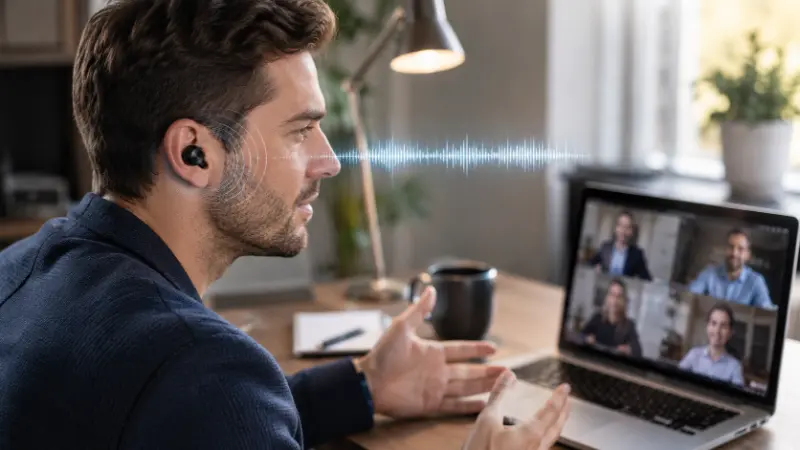
This is the one category where the gap to premium earbuds is still real. Cheap microphones tend to flatten your voice into mush the moment there’s wind or background noise — this shows up constantly in owner complaints, more than almost any other single issue.
Look specifically for multi-mic arrays with active noise reduction on the microphone side (sometimes labeled ENC, for environmental noise cancelling, which is a different system from ANC and works on your outgoing voice rather than what you hear). The Redmi Buds 8 Pro and CMF Buds 2A are both called out for handling wind noise on calls noticeably better than older budget models. If calls are genuinely your top priority — work calls, video meetings, anything where being understood matters — this is worth reading actual review transcripts for, since call quality is one of the easiest things for marketing copy to overstate and one of the easiest things for a real review sample to expose.
Best budget earbuds for bass
The Sony WF-C710N delivers full, controlled bass without the muddiness cheaper drivers introduce — Sony tunes for punch rather than boom, which keeps mids and vocals from getting buried underneath. If you want something more aggressively bass-forward out of the box, Anker’s Soundcore line tends to lean warmer and heavier in the low end by default, and most Soundcore models let you flatten that curve through the app’s EQ if it turns out to be too much for genres like acoustic or spoken-word podcasts.
Buy this if: your listening is mostly hip-hop, EDM, or anything bass-heavy, and you want impact without distortion at higher volumes.
Best budget earbuds for sound quality
For balanced, detailed sound rather than a boosted curve in one direction, the Sony WF-C710N and EarFun Air Pro 4+ are the current standouts. The EarFun model in particular supports Hi-Res codecs — LDAC and aptX Lossless — that most budget competitors skip entirely, which meaningfully improves detail on Android devices that support those codecs.
It’s worth understanding what those codec names actually mean, since “Hi-Res” gets thrown around loosely in marketing copy: LDAC (Sony’s codec) can transmit audio at bitrates up to roughly 990kbps, well above standard Bluetooth streaming. AptX Lossless (Qualcomm’s codec, Android-only) targets true CD-quality 16-bit/44.1kHz transmission. AAC, the default on Apple devices and many budget earbuds, tops out much lower. None of this matters if you’re streaming Spotify at its standard 320kbps — any codec handles that fine — but if you pay for Tidal, Amazon Music HD, or Apple Music’s lossless tier, LDAC or aptX Lossless support is the difference between actually hearing that upgrade and not.
Best budget earbuds for workouts
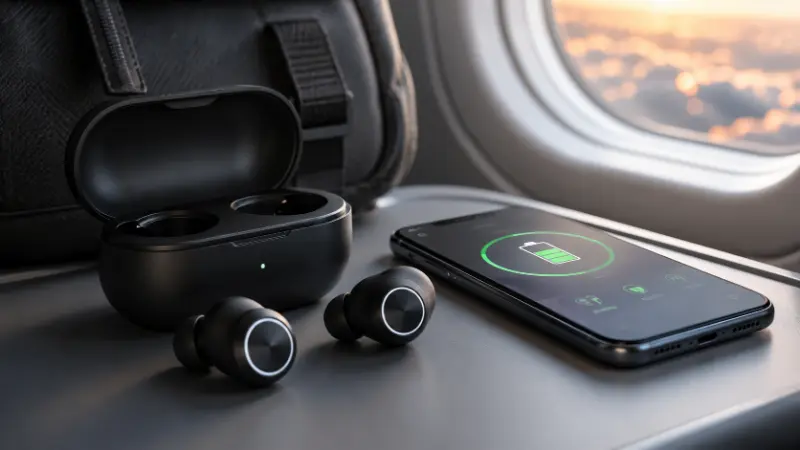
For workouts, fit security matters more than any audio spec — the best-sounding earbuds in the world are useless if they’re on the gym floor two minutes in. Look for an IPX4 rating minimum (sweat and splash resistant), consider ear hooks or stability wings for high-impact training like running or HIIT, and pay attention to where touch controls sit — a flush touch panel that requires a firm tap can push the whole earbud deeper into your ear or knock it loose mid-set, which is one of the most common workout-specific complaints in owner reviews.
Buy this if: you run, lift, or do any activity where “it might fall out” is a dealbreaker, not a minor annoyance.
Best budget earbuds for small ears
This deserves more attention than most guides give it, because it’s genuinely underserved at every price point, not just budget. Fit comes down to two separate things: the outer shell size and the nozzle width. A smaller ear tip cannot fix a housing that’s simply too large for your ear — that’s a shape problem, not a seal problem, and swapping tips won’t solve it.
The TOZO T6 stands out specifically because it ships with six ear-tip sizes and a notably thin nozzle profile built for smaller ear canals — a real, deliberate design choice rather than an afterthought. On the other end, reviewers have flagged the Nothing Ear (a) as running large and less suited to smaller ears, which is worth knowing before you buy based on its ANC reputation alone.
If you’ve had earbuds constantly work loose, feel like they’re applying pressure within an hour, or simply never feel “in” the way they’re supposed to, shop this as its own category rather than assuming any earbud with “multiple tip sizes included” will solve it. Extra tip sizes help with seal; they don’t fix an oversized shell.
Best budget earbuds with multipoint
Multipoint Bluetooth — staying connected to two devices at once, like a laptop and a phone, with audio switching automatically to whichever one is active — used to be locked to premium models. It’s now common well under $100. The Anker Soundcore Liberty 4 NC includes it alongside ANC and transparency mode, all under $100, and Sony’s budget WF-C510 added multipoint as a genuinely useful upgrade over its predecessor.
The practical value here is bigger than it sounds on a spec sheet: if you regularly switch between a work laptop and a personal phone, multipoint means you stop manually re-pairing in your Bluetooth settings every single time. It’s a small daily friction removed, dozens of times a week.
Best budget earbuds with wireless charging
Wireless charging cases are now standard on several sub-$100 models, including the Soundcore Liberty 4 NC and EarFun Air Pro 4+. It’s a smaller convenience than ANC or battery life — worth knowing that wireless charging is typically slower than the included USB-C cable, so it’s realistically an overnight top-up feature rather than something you’d rely on for a fifteen-minute emergency charge before heading out the door.
Buy this if: you already own a wireless charging pad for your phone and want one less cable on your desk. Skip it if you’re chasing every possible feature regardless of whether you’ll use it — this is genuinely a “nice to have,” not a “need to have.”
Best budget earbuds with Bluetooth 5.3
Bluetooth version affects connection stability, range, and power efficiency more than it affects sound quality directly. Version 5.3 (and the newer 5.4/6.0 chips now showing up in higher-end budget models like the EarFun Air Pro 4+) meaningfully reduces the dropouts and stutter that plagued earlier Bluetooth 5.0 and 5.1 budget earbuds, especially in crowded signal environments — packed commuter trains, busy offices, festival crowds.
This is worth checking directly on the spec sheet before buying, because it’s an easy filter: a lot of ultra-cheap earbuds, including some genuinely decent ones like the JLab Go Air Pop, still ship on Bluetooth 5.1, which is fine for most casual use but more prone to interference in crowded wireless environments than 5.3 or newer. If your last pair of cheap earbuds constantly cut out or lagged during video, checking this one spec before you buy again is the single fastest way to avoid repeating that problem.
Best budget earbuds with app support
A companion app is what separates earbuds you’re stuck with from earbuds you can actually tune to your own ears. Look for custom EQ, adjustable ANC/transparency strength, find-my-earbuds location support, and — the sleeper-important one — regular firmware updates. Brands that push firmware updates after launch fix real bugs (connection drops, mic issues, battery calibration problems) over time; cheaper white-label brands frequently ship once and never touch the software again.
The Anker Soundcore app and EarFun’s app are both consistently rated as full-featured and reliable rather than the barebones, ad-cluttered apps that plague some no-name budget listings. JLab’s app is another solid, unfussy option, offering multiple EQ presets and touch-control customization on models as cheap as the Go Pop+.
Best budget earbuds with microphone
Every earbud technically “has a microphone” — the real differentiator is the number of mics in the array and whether there’s software noise suppression handling wind and ambient sound. For clear voice pickup on calls and with voice assistants, the same models flagged in the Phone Calls section apply here: the Redmi Buds 8 Pro and CMF Buds 2A specifically call out improved handling of wind and ambient noise, which is the real test that matters more than a “has a mic” checkbox on a spec sheet.
Best waterproof budget earbuds
Here’s something worth being blunt about: no budget earbud on the market is actually “waterproof” in the way that word implies to most shoppers. What you’re really shopping for is an IP rating, and the difference between ratings is significant. IPX4 (the most common budget-tier rating, found on the JLab Go Air Pop, Go Pop+, and many others) means splash and sweat resistant — fine for rain, gym sweat, and general weather. IP55 or higher, and especially IPX7/IPX8-rated models, means genuine resistance to sustained water exposure, including brief submersion in some cases.
If you see “waterproof” in a product title with no IP rating listed anywhere in the actual spec sheet, treat that as a red flag rather than a feature — it’s exactly the kind of unverifiable claim that shows up on unfamiliar, ad-heavy listings with no real review history behind them, a pattern flagged repeatedly by actual buyers on forums after getting burned. No current budget earbud is rated for swimming; if that’s genuinely your use case, you need a dedicated swim-specific product, not general “waterproof earbuds” marketing language.
Best budget earbuds for commuting

Commuting is really three of the categories above combined: ANC to block train, bus, or traffic noise, battery life to survive a full commute plus a workday without a midday top-up, and Bluetooth stability to avoid dropouts in crowded stations where dozens of other devices are competing for the same wireless spectrum. The CMF Buds 2A and Sony WF-C710N both fit this combination well — strong adaptive ANC paired with dependable connection stability — at a price point where losing or damaging a pair on a crowded platform isn’t a $250 disaster.
Pain points that show up again and again (and how to avoid them)
Across owner reviews, Reddit threads, and forum complaints, the same handful of problems come up over and over, regardless of brand:
- Connection drops mid-song or mid-call, usually tied to older Bluetooth versions or genuinely crowded wireless environments. Check for Bluetooth 5.3 or newer if this has burned you before.
- ANC that looks great on the spec sheet but does little in practice — almost always a seal problem, not a chip problem. Try every included tip size before concluding the ANC underperforms.
- Muffled or “underwater”-sounding transparency mode — a reliable sign of lower-quality transparency processing, worth testing in person or checking a retailer’s return policy before committing if you’ll use it daily.
- Call quality collapsing the moment there’s wind or background noise — still the clearest remaining gap between budget and premium tiers.
- One earbud dying before the other, sometimes within a year or two — a pattern that comes up repeatedly in long-term owner reports, usually tied to moisture or earwax buildup in the mic/speaker mesh over time, with no serviceable filter on most models. Regular cleaning genuinely extends lifespan here.
- Housing too large for smaller or narrower ears — no amount of tip-swapping fixes a shell that’s the wrong shape to begin with.
- Distrust of unknown, heavily-advertised brands with no real review history. This shows up constantly in forum threads — people seeing an earbud ad everywhere, searching for actual reviews, and finding nothing substantial. That absence of independent verification is itself useful information. Stick to brands with an established track record and real third-party lab reviews, not just a product listing full of five-star reviews with no detail.
A quick note on Jabra
If you’re seeing “Jabra Elite” show up in older comparison content or forum threads, it’s worth knowing the context: Jabra’s parent company, GN, announced in 2024 that it was exiting the consumer earbuds market entirely, discontinuing the Elite and Talk lines to focus on its hearing, enterprise, and gaming audio businesses instead. The Elite 10 Gen 2 and Elite 8 Active were the final consumer models. GN has said it will continue supporting existing customers for several years, and remaining stock is still sold through some retailers, but there won’t be another generation. If a guide is recommending a “new” Jabra pair in 2026, that’s a sign the content hasn’t been updated recently.
Frequently asked questions
Are budget earbuds actually good in 2026?
Yes, more than they’ve ever been. ANC, app-based EQ, multipoint connectivity, and multi-day battery life have all moved solidly into the sub-$100 range. The clearest remaining gap versus premium models is call-microphone performance in wind or noisy environments — everything else has narrowed significantly.
What’s the actual difference between cheap and expensive earbuds?
Mostly build quality, microphone performance, and sound refinement at the margins. The best budget pairs can genuinely outperform some overpriced mid-tier options; the best premium pairs still edge out budget models on detail, dynamics, and call clarity, particularly in difficult acoustic conditions like wind or crowded rooms.
What should I look for in wireless earbuds under $50?
Prioritize an honest IP rating (IPX4 minimum), a Bluetooth version of 5.2 or newer, and a return policy you can actually use — fit varies enormously person to person, and even a well-reviewed pair can be wrong for your specific ears.
Are cheap wireless earbuds that aren’t from a known brand worth the risk?
Generally, no — or at least, proceed carefully. Established budget brands (Anker/Soundcore, JLab, Sony, EarFun, TOZO, CMF, JBL) publish real spec sheets that hold up to independent testing and have support infrastructure if something breaks. Unfamiliar brands with big battery or “waterproof” claims and no independent review history are the most common source of buyer disappointment in this category — this pattern shows up constantly in owner complaints online.
Is ANC on budget earbuds actually effective, or just a marketing checkbox?
It varies by model, which is exactly why picking a tested one matters. The stronger budget ANC options meaningfully quiet engine noise, HVAC hum, and steady background drone. None of them match flagship-level ANC against sudden, sharp, or high-pitched sounds like voices or car horns — that’s true at every price point, not just budget.
What Bluetooth codec should I care about — LDAC, aptX, or AAC?
Only matters if you stream lossless or Hi-Res audio (Tidal, Amazon Music HD, Apple Music Lossless). LDAC and aptX Lossless are meaningfully better than AAC or SBC for that specific use case. For standard streaming quality (Spotify at 320kbps, YouTube, podcasts), the difference is not something most people can reliably hear.
Can I find wireless earbuds that actually fit small ears?
Yes, but it’s worth shopping for specifically rather than assuming a “universal fit” claim applies to you. Look for models that explicitly ship with extra-small tip sizes and describe a low-profile or compact shell — the TOZO T6 is a current example built around this specifically.
Do budget earbuds work for calls and video meetings?
Mostly yes, with real caveats. Multi-mic models with active noise reduction on the microphone side (like the Redmi Buds 8 Pro or CMF Buds 2A) handle this reasonably well. Single-mic budget models tend to struggle noticeably the moment there’s wind or ambient noise, which is worth knowing before you rely on them for work calls.
Are budget earbuds durable enough for daily use over a year or more?
It’s genuinely mixed, and this is one area where owner reports diverge sharply from marketing claims. The most common long-term failure pattern is one earbud degrading before the other, generally linked to moisture and earwax buildup over 18–24 months of regular use. Established brands with real warranty support are a safer bet here than unfamiliar listings, purely because you have recourse if it happens.
What actually separates the best budget pick from the rest right now?
No single pair wins everything — that’s the honest answer, and any guide claiming otherwise is oversimplifying. The Sony WF-C710N and CMF Buds 2A currently lead on ANC and all-around balance. The EarFun Air Pro 4+ leads on battery life and codec support. The TOZO T6 leads specifically for small ears. Pick based on which of the fifteen categories above actually matches how you’ll use them, not which single name shows up most often in “best overall” lists.