
Best Portable Charger for Travel in 2026: What Actually Matters (Not What’s Being Sold to You)

If you’ve searched this before, you’ve probably noticed something: almost every “best portable charger for travel” article is written by the company trying to sell you their charger. That’s not an accusation, it’s just how this niche works — and it means most of what you’ll read ranks its own product first, no matter what the honest answer would be.
This guide doesn’t sell chargers. It’s here to help you understand what actually matters, what the 2026 airline rules really say, and which type of charger fits your specific trip — with real trade-offs stated plainly, including the times a cheaper or smaller option beats the “best” one.
Quick answer: For most travelers, the best portable charger for travel is a 10,000mAh USB-C power bank with 20W+ fast charging, under 100 watt-hours, ideally with a built-in cable. That covers roughly two full phone charges, clears airline security everywhere in the world without special approval, and is light enough that you’ll actually carry it instead of leaving it in your hotel room. If you’re traveling with a laptop or tablet too, you’ll want a 20,000mAh+ bank with 65W or higher output instead — more on that below.
Why This Is Genuinely More Complicated in 2026 Than It Used To Be
If the last charger you bought was more than a year ago, some of what you knew has changed. Several major U.S. airlines tightened lithium-ion battery rules through 2026 after a rise in reported battery-related incidents on aircraft:
- American Airlines and Delta now cap passengers at two portable chargers, each 100Wh or under, a policy that took effect May 1, 2026.
- Southwest limits travelers to one power bank per person and no longer allows chargers to be stored in overhead bins.
- United requires portable chargers to stay in plain sight for the entire flight, not packed away in a bag under the seat.
None of this means power banks are being phased out — they’re still allowed everywhere. It means the details that used to be optional (“just toss it in your carry-on”) now actually matter, and packing whatever charger you already own without checking it is a real way to have it confiscated at the gate.
How to Actually Choose a Portable Charger for Travel
Most buying guides lead with capacity because it’s the easiest number to compare. In practice, capacity is maybe the third most important factor. Here’s the order that actually affects your trip:
1. Airline compliance comes first
A charger that gets pulled at security is worthless no matter how many charges it holds. Every other decision should happen inside this constraint, not around it.
2. Output wattage, not just capacity
A 20,000mAh power bank that only outputs 10W will trickle-charge a modern phone — you’ll be tethered to it for over an hour for a meaningful top-up. Look for:
- 20W+ USB-C output for phones (this is what enables real fast charging)
- 65W+ output if you’re also charging a laptop or tablet
- USB-PD (Power Delivery) support specifically — this is the standard that unlocks fast charging on iPhones and most modern Android phones. A charger without it will still work, just slowly.
3. Weight-to-capacity ratio
Two 10,000mAh power banks can differ by 50+ grams depending on the battery cells used inside. That sounds trivial until it’s in a daypack you’re wearing for 8 hours of sightseeing.
4. Built-in cable vs. loose cable
A dangling USB cable is one of the most commonly lost or forgotten travel items — it falls out of bags, gets left in hotel outlets, snaps at the connector. Chargers with an integrated cable solve this, at the cost of some flexibility if you own devices with different port types (USB-C phone, Lightning earbuds case, for example).
5. Retractable cables are a smaller but real upgrade
A growing number of 2026 power banks now use retractable, built-in USB-C cables instead of a fixed short cable. It’s a small feature, but it solves the specific annoyance of a built-in cable being too short to reach an awkward outlet — worth the small price premium if you’ve been burned by that before.
6. Pass-through charging
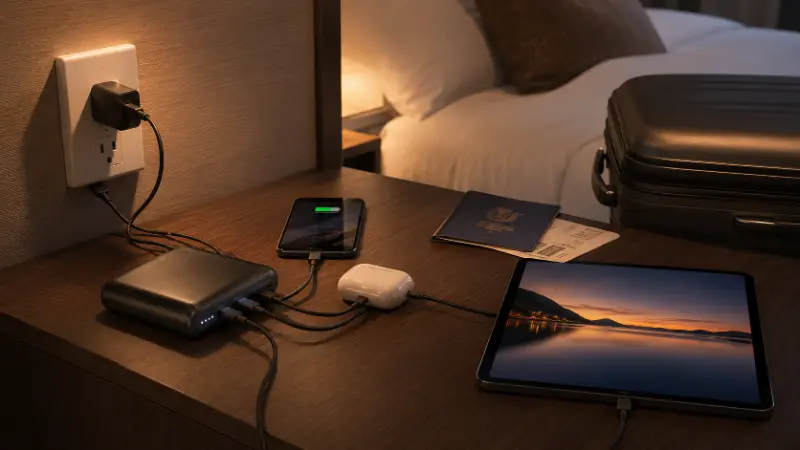
Some banks let you charge the power bank itself and a connected phone at the same time overnight. This matters more than people expect in hostels, Airbnbs, or shared outlets where you only get one plug and need both devices topped off by morning.
7. Multi-device output
If you’re traveling with a phone, earbuds case, and a tablet, a bank with 2–3 output ports saves you from constantly swapping cables mid-charge.
The 2026 TSA and Airline Rules, Explained Without the Legal Language
Here’s what actually happens at the airport, not just what the regulation technically says.
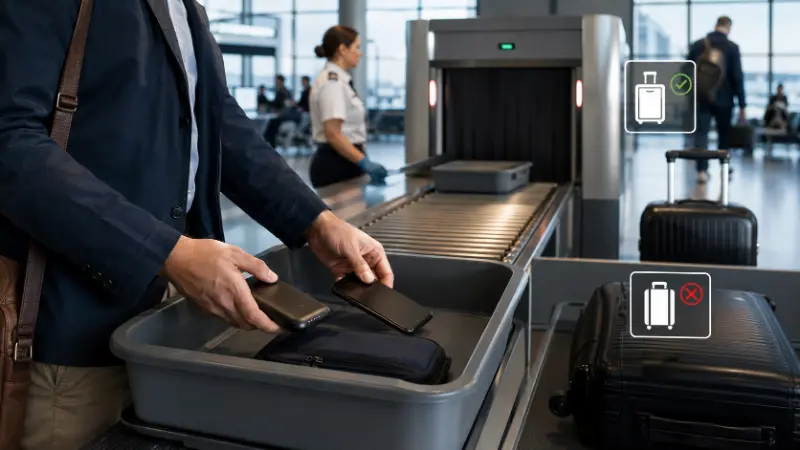
The universal rule, no exceptions: lithium-ion power banks travel in your carry-on or personal item, never in checked luggage. This applies globally — it’s not a U.S.-only rule, and every major airline and the IATA follow it.
The 100 watt-hour line:
- Under 100Wh: no special approval needed, and TSA doesn’t cap how many you carry (though airlines often set their own lower limits — see below)
- 100–160Wh: requires airline approval, typically capped at two batteries
- Over 160Wh: prohibited on commercial flights, full stop
How to calculate your charger’s Wh rating
Power banks are almost always labeled in mAh, but the rule is in Wh. The conversion:
Wh = (mAh ÷ 1000) × 3.7
| Capacity | Approximate Wh | TSA Status |
|---|---|---|
| 5,000mAh | ~18.5Wh | Well under the limit |
| 10,000mAh | ~37Wh | Well under the limit |
| 20,000mAh | ~74Wh | Under the limit |
| 27,000mAh | ~100Wh | At the ceiling |
| 30,000mAh+ | ~111Wh+ | Needs airline approval |
If the Wh rating isn’t printed on the device itself, that’s a problem — TSA agents look for a legible, printed rating, and a missing or worn-off label is one of the more common reasons a charger gets flagged and pulled aside, even if the actual capacity would have been fine.
What individual airlines require in 2026
| Airline | Charger limit | Storage rule |
|---|---|---|
| American Airlines | 2 chargers, 100Wh each | Standard carry-on |
| Delta | 2 chargers, 100Wh each | Standard carry-on |
| Southwest | 1 charger | Not allowed in overhead bins — must stay with you |
| United | No stated numeric cap, but strict | Must remain in plain sight for the entire flight |
Airline rules change without much notice, so if you’re flying soon, it’s worth a 30-second check of your specific airline’s current policy page before you pack — don’t rely on what was true a year ago, or even six months ago.
Why this is a safety rule, not bureaucracy for its own sake
Lithium-ion batteries can undergo something called thermal runaway — a chain reaction where internal damage or a short circuit causes the battery to heat rapidly, sometimes leading to fire. It’s rare, but when it happens in a cargo hold, the crew has no way to reach it mid-flight. That’s the actual reasoning behind “carry-on only, never checked”: the cabin has fire-suppression equipment and immediate crew access; the hold doesn’t. It’s also why airlines now want chargers visible and accessible instead of buried in an overhead bin — if something starts to swell, smoke, or heat up, someone needs to be able to grab it and act immediately.
A Quick Word on Battery Cells (Why Not All “10,000mAh” Chargers Feel the Same)
Almost all consumer power banks use one of two lithium battery types:
- Lithium-ion (Li-ion): higher energy density, generally cheaper, slightly bulkier per mAh
- Lithium-polymer (Li-Po): can be shaped thinner and lighter, often used in the ultra-slim “card style” chargers, usually a bit more expensive per mAh
This is why two chargers with an identical mAh rating can differ noticeably in size, weight, and price — you’re not just paying for capacity, you’re paying for the cell type and how efficiently it’s packaged.
Best Portable Chargers for Travel, by Situation
Specs, pricing, and availability shift constantly in this category. Treat this as a shortlist of categories and credible examples to research current pricing on — not a final, unchanging ranking.
Best overall for most travelers
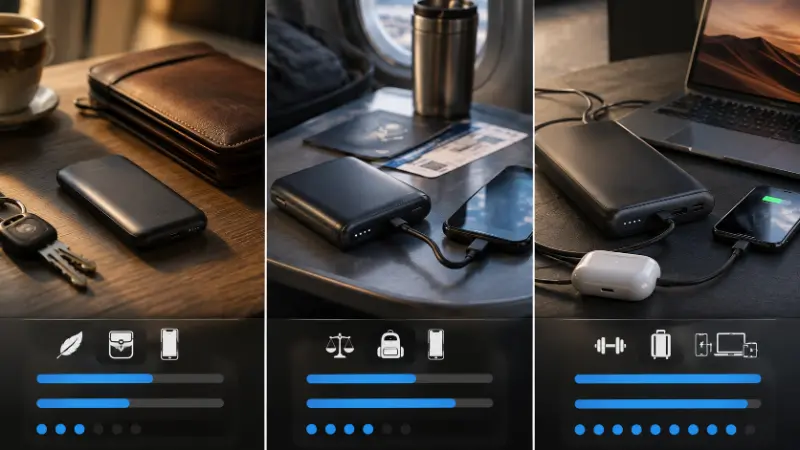
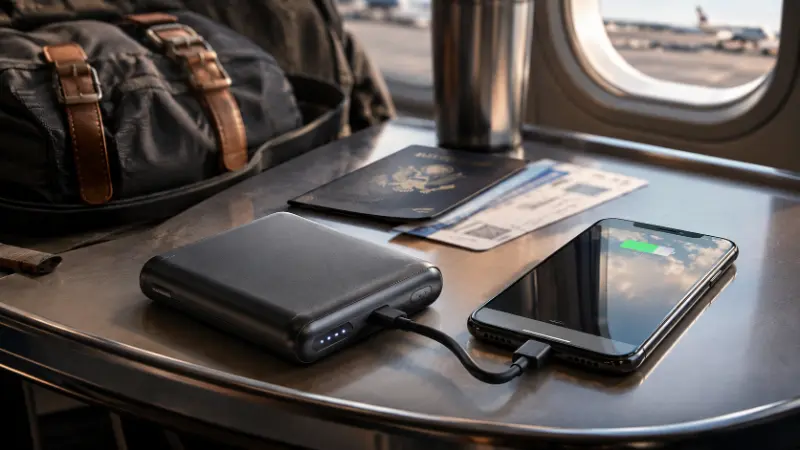
A ~10,000mAh, 20–30W USB-C power bank with a built-in cable and an LED charge indicator. Anker’s Nano and PowerCore Slim lines, and UGreen’s Nexode series, are common, well-reviewed examples in this exact category. Small enough for a jacket pocket, strong enough for roughly two full phone charges.
Best ultra-slim / everyday carry
Card-style chargers around 5,000mAh with a built-in cable, thin enough to live permanently in a passport wallet or back pocket. The tradeoff is capacity — about one full phone charge — but the real-world advantage is that a charger you always have on you beats a bigger one left in a hotel room.
Best ultralight for backpacking
Purpose-built ultralight banks (Nitecore’s NB-series is a known example) use carbon fiber or similarly weight-optimized shells to shave grams while holding roughly 10,000mAh — relevant if you’re counting every gram in a backpack rather than a suitcase.
Best for laptop + phone travelers
Higher-capacity bricks in the 20,000–25,000mAh range with 65–140W USB-C output function closer to a mini power station than a phone charger. Anker’s 737/PowerCore 24K-class banks and INIU’s Cougar laptop power bank line are examples worth comparing — worth the extra weight if you’re working on the road and need to keep a laptop alive between outlets.
Best for iPhone specifically
Look for explicit USB-PD support — this is what unlocks real fast charging on iPhones. A bank without it will still charge an iPhone, just slowly, regardless of its mAh rating. If you want cable-free charging, MagSafe-compatible magnetic power banks (Belkin and Anker both make well-known versions) are convenient, though wireless charging is consistently slower than a wired USB-C connection, so treat it as a convenience trade-off, not a speed upgrade. If you’re on an older Lightning-port iPhone (iPhone 8 through 14), you’ll need a charger with a Lightning cable or adapter — most 2026-era chargers now ship built-in USB-C cables by default, so this is worth double-checking before you buy if you haven’t upgraded phones recently.
Best for international and long-haul flights
A 20,000mAh bank with dual USB-C ports and 65W+ output covers a phone and a tablet or laptop without needing two separate chargers, while staying comfortably under the 100Wh ceiling that applies on every international carrier, not just U.S. airlines. This is also the traveler most worth double-checking foreign airline policy for — some Southeast Asian budget carriers apply stricter effective limits even without formal approval requirements.
Best for camping, road trips, and off-grid stretches
This is a different product category worth distinguishing clearly: a power bank (what this whole guide covers) charges phones and small electronics. A portable power station (Jackery and Goal Zero are the recognizable names here) is a much larger, heavier unit meant to run larger devices or provide backup power over multiple days, often paired with a foldable solar panel. If your trip involves multiple days without any outlet access at all, a 20,000mAh+ power bank simply isn’t the right tool — that’s a power station question, not a “best portable charger” one.
Best budget pick
A basic 10,000mAh single-port USB-C bank with no extra features. It won’t wow anyone, but it covers the core job: roughly two phone charges, fully TSA-compliant, and cheap enough that losing it isn’t a crisis.
The Two-Charger Habit Frequent Travelers Actually Use
This doesn’t show up in most buying guides, but it’s a pattern real travelers describe consistently: carry two smaller chargers instead of one large one, and keep one charging while the other is in use. The logic is simple — a single power bank recharges slowly, so if you only own one, you’re stuck choosing between an empty charger and an empty phone at the worst possible moment. Two 10,000mAh banks in rotation solve this without ever exceeding airline per-charger limits, and it’s a more airline-friendly strategy than trying to carry one oversized 25,000mAh brick.
Common Problems Travelers Actually Run Into
- “It died before my trip even started.” Usually means it wasn’t charged to 100% the night before, or output wattage didn’t match what the phone actually needed. Charge it the evening before travel, not the morning of.
- “It got flagged or taken at security.” Almost always a missing or unreadable Wh label, or a capacity that crept over 100Wh without the traveler realizing it. Check the printed rating before you pack, not at the checkpoint.
- “It’s too bulky to carry daily.” A real trade-off, not a defect — higher capacity means more bulk. For daily carry, a slim 10,000mAh bank plus a habit of recharging it overnight usually beats one giant brick you stop bringing along after week one.
- “It stopped holding a charge after a few months.” Cheap, unbranded power banks — especially ones bought purely on lowest price from marketplace listings with no recognizable brand — often use lower-grade cells that degrade fast. This is a safety consideration as much as a performance one: Belkin issued a 2026 recall on one of its power bank models over a fire risk, a reminder that even established brands aren’t automatically exempt, and it’s worth registering any charger you buy and watching for recall notices.
- “It won’t fast-charge my iPhone.” Needs USB-PD support specifically — a standard USB-A output will trickle-charge an iPhone regardless of the bank’s total capacity.
Frequently Asked Questions
What is the best portable charger for travel?
For most travelers, a 10,000–20,000mAh USB-C power bank with 20W+ output and a built-in cable offers the best balance of charging capacity, weight, and airline compliance. Laptop travelers should size up to 20,000mAh+ with 65W or higher output.
Can I take a portable phone charger on a plane?
Yes. Lithium-ion power banks under 100Wh are allowed in carry-on baggage on every major airline worldwide. They’re never allowed in checked luggage, and several U.S. airlines now cap you at one or two chargers with specific in-flight storage rules — check your airline before flying.
Does TSA allow portable power banks?
Yes, as long as they’re under 100 watt-hours and packed in carry-on or a personal item, not checked baggage. Batteries between 100–160Wh need airline approval; anything over 160Wh isn’t allowed on commercial flights.
Why is it dangerous to use a portable charger on an airplane?
It isn’t dangerous to use one — using a power bank in flight is fully permitted. The restriction is about storage and battery condition: lithium-ion batteries carry a small risk of thermal runaway (rapid overheating), and a cargo hold doesn’t allow crew to reach a battery quickly if that happens, which is why they must stay in the cabin with you.
How do I choose the best portable charger for me?
Start with your trip type, not the spec sheet: phone-only day trips need roughly 10,000mAh, laptop-and-phone trips need 20,000mAh+ with 65W+ output, and off-grid multi-day trips are really a power station question, not a power bank one. From there, prioritize output wattage and a built-in cable over raw capacity.
What’s the best power bank for iPhone?
Any USB-C power bank with USB-PD support will fast-charge an iPhone properly. MagSafe magnetic banks are convenient for cable-free charging but noticeably slower than a wired connection — treat wireless as a convenience trade-off, not a speed upgrade.
Can a portable charger charge a laptop?
Yes, if the power bank supports USB-C Power Delivery at 65W or higher and your laptop charges via USB-C. Most standard 10,000mAh phone-focused banks don’t have the wattage for this — you’ll need a higher-capacity, higher-wattage bank built for it.
What type of battery cells do power banks use?
Almost all use either lithium-ion (higher capacity per dollar, slightly bulkier) or lithium-polymer (thinner, lighter, typically pricier per mAh) — which is why two chargers with the same mAh rating can differ noticeably in size and weight.
What else can a power bank be used for besides charging a phone?
Beyond phones, common uses include keeping tablets, wireless earbuds cases, e-readers, handheld gaming devices, and smartwatches charged on long travel days, and higher-wattage models can top off a laptop. Some also double as an emergency light source or, in outdoor-focused models, a way to keep a GPS device or satellite communicator running on multi-day trips.
How many mAh do I need for international travel specifically?
It depends on outlet access, not trip length. If you can recharge the bank nightly (hotel, Airbnb), 10,000–20,000mAh covers the whole trip regardless of how many days you’re gone. Only go higher-capacity for treks or stretches without reliable nightly outlet access.
Related: best budget smartphones, best VPN for beginners, best AI gadgets