
Are Free VPNs Safe? The Real Answer for Gamers in 2026

Quick heads up before we start: some of the links in this post are affiliate links, meaning we might earn a small commission if you sign up through them. It doesn’t cost you anything extra, and it doesn’t change what we’re about to tell you — half the point of this post is telling you which free VPNs to actually avoid, commission or not.
Written by someone who’s spent way too many nights rage-quitting to a bad connection and, yes, tried a sketchy free VPN or two before learning better. Last checked and updated: August 2026.
Are Free VPNs Safe? The Short Answer
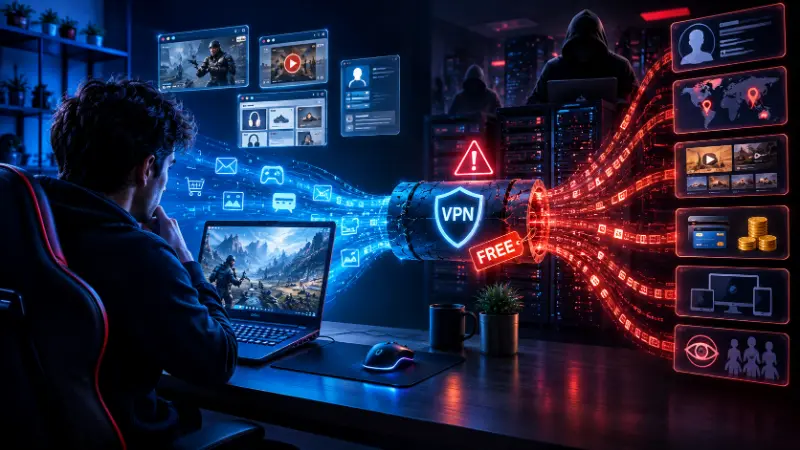
So, are free VPNs safe to use in 2026? Most of them, no. Full stop. Running VPN servers costs real money, and if a company isn’t charging you for it, they’re making that money some other way — usually by logging your activity, selling your data, throwing ads at you, or in the worst cases, quietly bundling in malware.
There are exceptions. A small handful of free VPNs — Proton VPN’s free plan is the clearest example — are backed by companies with real paid businesses and independently audited no-logs policies, so their free tier is genuinely safe. But “safe for privacy” and “good for gaming” are two completely different questions, and almost nobody talks about the second one. That’s what this post actually covers.
Why Free VPNs Are Risky in the First Place
Old saying that’s still true in 2026: if you’re not paying for the product, you are the product.
A VPN app sits between you and literally everything you do online — every game server you connect to, every login, every DM. That’s a huge amount of access to hand over to a company that isn’t charging you a cent. Free VPNs typically make their money one of a few ways, and most of them work against you, not for you:
- Selling your browsing and connection data to advertisers or data brokers
- Logging your activity even when the app claims “no logs” on the homepage
- Injecting ads or trackers directly into your traffic
- Bundling the app with malware or adware
- Throttling your speed and capping your data hard enough to push you toward a paid upgrade
This isn’t a “maybe.” Independent security research has been documenting this pattern for years, and it hasn’t gotten better:
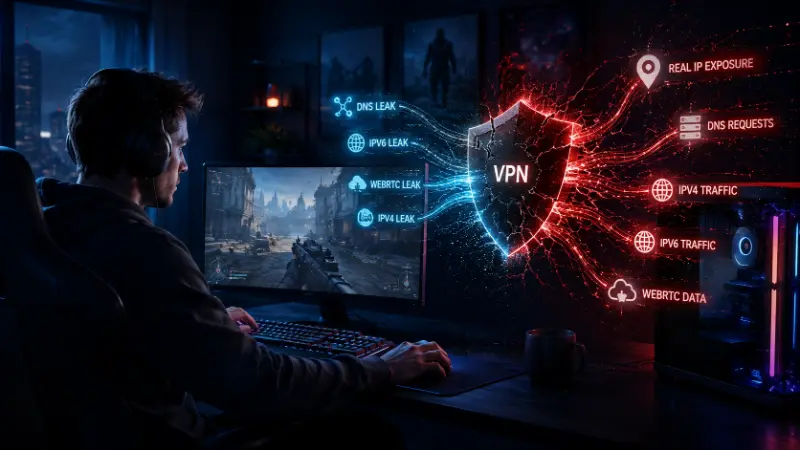
- A large-scale test of top free Android VPNs found the majority leaked identifying data through DNS, IPv4, IPv6, or WebRTC leaks — meaning the app was supposedly “protecting” you while your real IP was visible the whole time
- A CSIRO-backed study of 283 Android VPN apps found the majority contained third-party tracking libraries, and some even performed TLS interception — basically peeking inside traffic that’s supposed to be encrypted
- Independent malware scans have flagged roughly one in five popular free VPN apps outright
- Government cybersecurity agencies have specifically warned that personal VPNs don’t eliminate risk — they just shift it from your internet provider to whatever company runs the VPN, and if you don’t know who that company is, you’ve traded a known risk for an unknown one
What Actually Goes Wrong: The Real Risk List
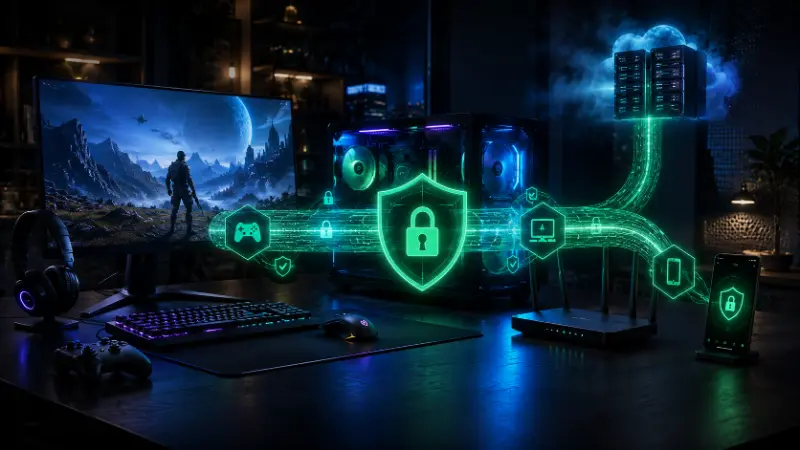
If you strip it down, “is a free VPN safe” really breaks into five separate questions:
- Data harvesting — is the app selling your search history, location, or personal info to advertisers?
- Traffic leaks — is it actually hiding your DNS requests and real IP, or just pretending to?
- Malware and trackers — is there hidden code monitoring your device beyond what the VPN needs to function?
- Weak or missing encryption — is your traffic actually protected, or just wrapped in something that looks like protection?
- Speed and bandwidth — even if it’s “safe,” can you actually use it without it falling apart mid-session?
Most free VPN horror stories are really just one or more of these five things going wrong at once.
The Gaming Problem Nobody Talks About
Here’s what every other article on this topic misses: gamers hit a completely different set of problems than someone just trying to browse safely on airport wifi.
Can a Free VPN Actually Improve Gaming Speed?
Sometimes, but rarely on a free plan. A VPN can lower your ping if your ISP is routing you badly or throttling gaming traffic during peak hours — connecting to a server that sits closer to the game’s actual servers can shortcut a bad route. But that only works if the VPN has enough server locations and bandwidth to route you well in the first place. Free tiers usually don’t. You’re stuck on a handful of overcrowded shared servers, which means more jitter and higher ping, not less — the opposite of what you wanted.
Does a Free VPN Protect Against DDoS Attacks While Gaming?

This is the actual reason a lot of gamers look for a VPN in the first place. Some toxic player in a lobby grabs your IP through voice chat or a peer-to-peer connection and floods your router until you disconnect. A VPN masks your real IP behind its own server, which helps — but only if that server has the infrastructure to absorb an attack. DDoS mitigation is expensive to run, and free VPNs are built to avoid exactly that kind of cost. Most offer weak or zero real DDoS protection, so you end up with the privacy risk of a random app and none of the protection you actually needed.
Will a Free VPN Get Me Banned or Flagged In-Game?
Rarely for using a VPN itself — most games are fine with it. The real risk is that free VPN IP ranges get reused across thousands of unrelated apps, and unfortunately, a lot of abuse and fraud too. Anti-cheat and anti-fraud systems are more likely to flag traffic coming from those IPs, even if you’re doing nothing wrong. A handful of competitive titles also explicitly restrict VPN use in ranked modes for region-lock reasons, so it’s worth checking your specific game’s terms before you connect one.
Why Do Free VPNs Disconnect or Lag Out Mid-Match?
Usually bandwidth caps. Free tiers commonly limit you to somewhere between 500MB and 10GB a month, or throttle you hard after a certain point in the day. A single ranked session, a big patch download, or a couple hours of cloud gaming can burn through that fast — and when it’s gone, your connection either drops or crawls.
Safe vs. Unsafe: How to Actually Tell the Difference
“Free VPN” isn’t one category — it’s a spectrum from “genuinely fine” to “please uninstall this immediately.” Here’s what actually separates the two ends.
Signs a free VPN is probably safe:
- It’s the free tier of a company whose main business is a paid, subscription-funded product — Proton VPN and Windscribe are the two most commonly cited examples
- The no-logs claim has been independently audited by a named third-party security firm, not just stated on the marketing page
- It has a real, specific privacy policy about what’s collected and why — not a vague “we value your privacy” paragraph
- It supports a kill switch, the feature that cuts your internet entirely if the VPN connection drops, so you’re never accidentally exposed unencrypted
- It’s transparent about who owns the company and where they’re legally based
Red flags that mean skip it:
- It asks for permissions it has no reason to need — camera, contacts, call logs, and precise location aren’t things a VPN needs
- The privacy policy is short, generic, and hasn’t been updated in years
- You genuinely cannot find out who owns or runs the company after a five-minute search
- There’s no kill switch or DNS leak protection on the free tier, even though the company advertises those features on paid plans
- It’s suddenly trending or spiking in app store charts with no real track record or reviews behind it — that pattern shows up around low-quality or malicious VPN apps fairly often
Does a VPN Affect Internet Speed?
Yes, always, to some degree — encrypting and rerouting your traffic adds overhead no matter what. The question is how much. Modern protocols like WireGuard add very little (often a single-digit percentage), while older protocols like standard OpenVPN can add noticeably more. Free VPNs often use older or less optimized protocols to cut server costs, which is part of why they tend to feel slower than paid options even before server congestion enters the picture.
Kill Switch and No-Logs: Do Those Actually Matter?
Yes, and they’re worth understanding since you’ll see both terms on every VPN’s marketing page.
A kill switch automatically cuts your device’s internet connection if the VPN drops unexpectedly. Without one, if your VPN disconnects mid-session, your traffic just falls back to your normal, unprotected connection — often without any obvious warning. For gaming specifically, this also matters for a non-privacy reason: it stops your real IP from suddenly becoming visible mid-match if the connection blips.
A no-logs policy means the provider claims not to record your browsing activity, connection timestamps, or IP address history. The word “claims” is doing a lot of work there — it only means something once it’s been independently audited by a real security firm. A no-logs claim with zero audit behind it is just marketing copy.
Which Free VPN Is Safe to Use? Our Picks
Based on independent audits, ownership transparency, and actual track record — not marketing claims — a short list clears the bar.
Proton VPN Free Unlimited data, no ads, and backed by the same independently audited no-logs infrastructure as Proton’s paid plans. The company is based in Switzerland, which has strong privacy law behind it. The trade-off: no server selection and a limited number of free server locations, so it won’t do much for ping specifically — but it’s a genuinely safe baseline option.
Windscribe (free tier) Publishes a specific, plain-language breakdown of exactly what minimal data is retained and why, rather than a vague privacy promise. Data is capped (commonly cited around 10GB/month for free users), which is fine for casual sessions but won’t survive a heavy gaming month.
PIA (limited free tier) Solid security fundamentals — no traffic storage, open-source app — but check current plan limits before relying on it for regular play, since free-tier availability and caps shift over time.
None of these are built for competitive gaming specifically. They’re built to be safe. If DDoS protection, consistently low ping, and unlimited data actually matter to your sessions — and for most online gaming they do — a budget paid VPN in the $2–5/month range from an audited provider will outperform every free option on this list, safe or not.
FAQ: Free VPN Safety
Are free VPNs trustworthy?
Most aren’t. A small number backed by real, audited paid businesses are the exception, not the rule. Check for an independent no-logs audit before trusting any of them.
Can the FBI or similar agencies track a VPN?
A VPN hides your traffic from your ISP and from the websites you visit, but it doesn’t make you invisible to a determined investigation — especially if the VPN provider keeps logs and can be legally compelled to hand them over. This is exactly why an audited no-logs policy and provider jurisdiction actually matter, not just as marketing buzzwords.
Which free VPN is the safest?
Proton VPN’s free tier is the most commonly recommended safe option currently, largely because of its audited no-logs policy and unlimited data on the free plan.
Do free VPNs sell your data?
Many do, directly or through “anonymized” data sharing with advertising partners buried a few paragraphs into the privacy policy. Read past the homepage promise and into the actual policy document before trusting a “no logs” claim.
Is it safe to use a free VPN on public wifi?
It’s better than nothing on an untrusted network, but only if the VPN itself is trustworthy — otherwise you’re just trading one set of prying eyes (the wifi network) for another (a shady VPN provider) instead of removing the risk.
Does a VPN slow down gaming specifically?
A little, almost always — but a well-routed VPN on a good protocol can sometimes offset that by fixing bad ISP routing. Free VPNs rarely have the server network to pull that off consistently.
Is a free VPN worse than using no VPN at all?
It can be. A bad free VPN can leak your IP anyway, meaning it fails at its one job, while also giving an unknown company deep visibility into your traffic you wouldn’t otherwise have handed over. No VPN is a known, understood risk. A bad free VPN is an unknown one — and unknown is usually worse.
The Bottom Line: Are Free VPNs Safe?
Most free VPNs aren’t worth the risk. A couple of exceptions exist for general safety, with Proton VPN Free being the clearest one — but even those aren’t built for serious gaming. If ping, DDoS protection, and reliable connections during ranked matches matter to you, that’s what paid, audited providers are actually for, and at a few dollars a month, it’s cheaper than the skins you’ll lose rage-buying after a bad disconnect.