
PUBG Mobile vs Free Fire 2026: The Honest Verdict Nobody Else Will Give You

PUBG Mobile vs Free Fire is one of the biggest gaming comparisons in 2026. Both battle royale games have hundreds of millions of registered players, but choosing between PUBG Mobile and Free Fire depends entirely on your device, your gameplay style, and how much time you have per session.
PUBG Mobile vs Free Fire in 2026 is not the same debate it was three years ago. Both games have evolved significantly, player demographics have shifted, the esports scenes have diverged in interesting ways, and device hardware has changed what each game can actually deliver. The answer that made sense in 2022 may be completely wrong for you today.
Here is what makes this comparison genuinely difficult: PUBG Mobile and Free Fire are not actually competing for the same player. They never were, even if it looks that way on the surface. They share the battle royale label the way a touring motorcycle and a city scooter share the word “bike” — technically accurate, wildly different in practice.
This guide covers everything that actually matters in 2026: real player numbers, honest PUBG vs Free Fire graphics breakdown, gameplay pacing, device requirements, monetization fairness, esports opportunity, and the specific type of player who will genuinely enjoy each game. I have spent more than 300 hours playing both PUBG Mobile and Free Fire across multiple devices over the past few years, and I will share the opinions that other comparison articles dance around.
One thing this guide does not do: declare a universal winner. That framing is lazy. The better question is which game is right for you — and by the end of this, you will know exactly which one that is.
Whichever side of this comparison you land on, cross-platform support is a real factor in the decision — we’ve covered whether PUBG Mobile is cross-platform in 2026 in detail. PUBG’s edge for a lot of players comes down to customization, from control layout and settings to fully custom PUBG skins once those settings are locked in. And if competitive shooters in general are more your speed than battle royale, Valorant Mobile is worth a look too.
How Big Are These Games Actually in 2026?
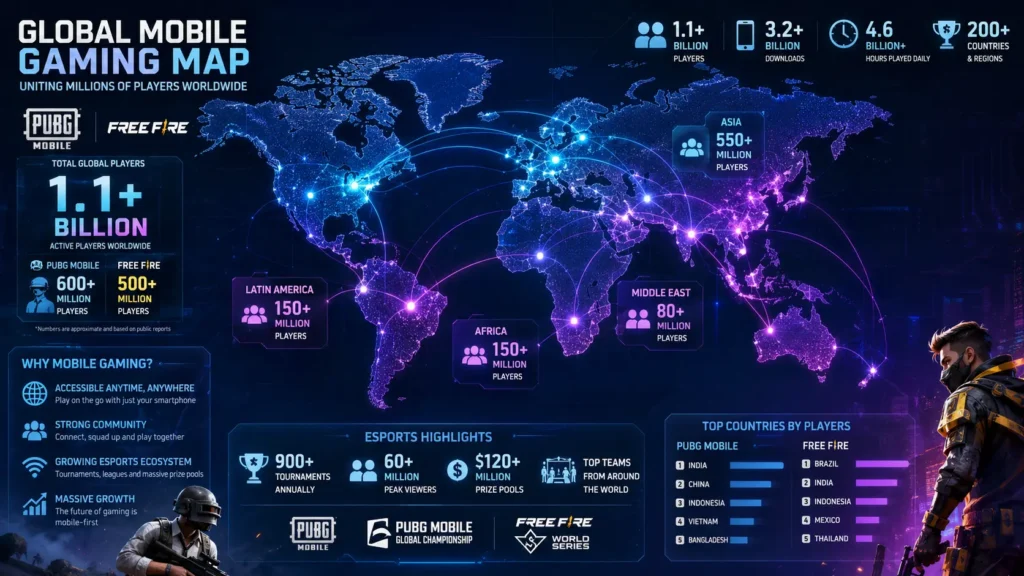
The numbers are real and they are staggering. Free Fire has 36.8 million monthly active players in 2026, while PUBG Mobile sits at 32.4 million monthly active players. Free Fire leads on raw player count, which surprises people who assume PUBG Mobile dominates globally. The reasons for that gap are more interesting than the numbers themselves.
Free Fire’s lead comes from its accessibility. It runs on almost any Android device made after 2016, which makes it the dominant choice across Southeast Asia, Latin America, and Sub-Saharan Africa — regions with enormous gaming populations but where flagship smartphones are not the norm. Free Fire is generally more popular in regions like Southeast Asia, Latin America, and India, largely due to its accessibility on low-end devices.
PUBG Mobile’s 32.4 million active players skew toward higher-income markets and device owners. The PUBG Mobile player base spends more per capita. PUBG Mobile earned around $2 billion in 2025 from seasonal passes and skins alone. That is an extraordinary number for a free-to-play mobile game and reflects the spending habits of its core audience.
Here is the contrarian take that most comparison pieces avoid: Free Fire winning on player count while PUBG Mobile wins on revenue tells you something important about each game’s identity. Free Fire is the people’s game — massively inclusive, globally distributed, and built around volume. PUBG Mobile is the premium experience — smaller audience, higher commitment, bigger individual spend. Neither is better. They serve different markets with different approaches, and both are winning.
PUBG vs Free Fire Graphics: Who Actually Wins?
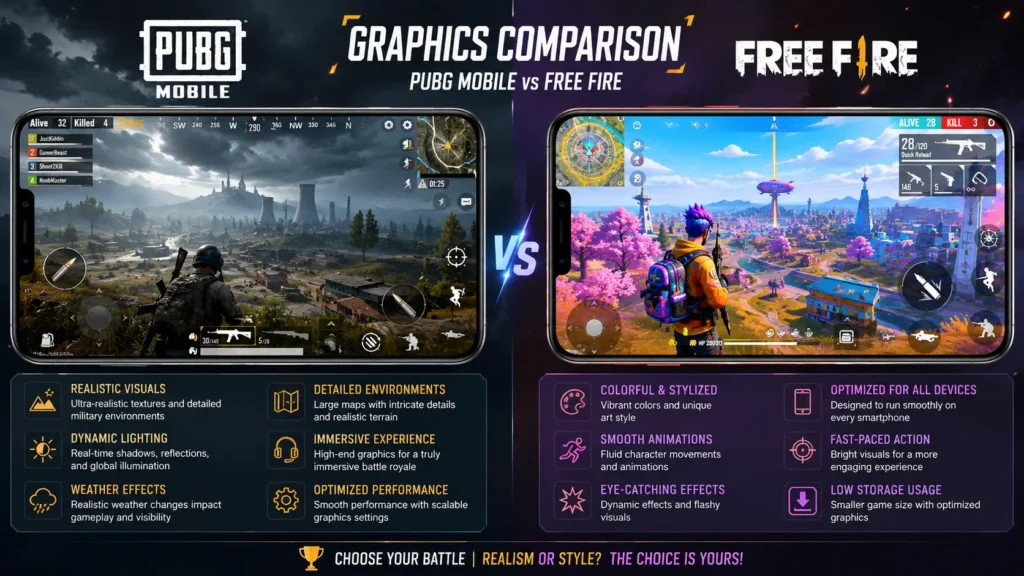
When comparing PUBG Mobile graphics vs Free Fire graphics, PUBG Mobile looks significantly better. It runs on Unreal Engine 4 and the difference is obvious the second you load in. This is not a close comparison. PUBG Mobile delivers realistic environments, detailed character models, authentic weapon textures, weather effects, and lighting that shifts dynamically across its maps. Standing in Erangel at sunrise with fog rolling across the fields is genuinely beautiful in a way that few mobile games match.
Free Fire uses a lighter proprietary engine with a deliberately stylized, more cartoonish visual approach. Free Fire Max has more cartoonish, animated graphics designed for accessibility on low-end devices. This makes the game inclusive for a broader audience but sacrifices some graphical fidelity.
Now here is the part that matters more than the graphics comparison itself: better graphics on a phone that cannot run them smoothly is worse than simpler graphics running at a locked 60 FPS. This is a practical reality that most tech-focused comparisons ignore.
If your phone is a Samsung Galaxy A-series from 2022 or 2023, or any mid-range Android device, PUBG Mobile may run inconsistently for you even on lower settings. Free Fire on the same device will run cleanly at a stable frame rate, which translates to better actual gameplay even if the screenshots look less impressive.
On flagship hardware — Snapdragon 8 Gen 3 or 8 Gen 4, Apple A17 or A18 chips — PUBG Mobile shines. The visual fidelity gap becomes genuinely meaningful and the game runs at 90 FPS on supported devices. If you own a high-end phone, PUBG Mobile gives you something closer to a console battle royale experience than anything else on mobile right now.
After more than 300 hours across both titles, here is what that difference actually looks like in practice. I tested both games on a Pixel 8a (mid-range, 2024 hardware) and a Galaxy S25. The experience gap between the two phones was minimal in Free Fire. In PUBG Mobile, the S25 session was noticeably smoother, more responsive, and more visually engaging. The Pixel 8a handled PUBG Mobile adequately but not beautifully. If you want to know how to get the best possible performance from either game, our guide on how to reduce lag in mobile games covers every setting worth adjusting before your next session.
PUBG vs Free Fire Gameplay: Fast Chaos vs Calculated Patience
This is where the Free Fire vs PUBG Mobile experience diverges most dramatically, and it is the most important factor in choosing which one suits you.
Free Fire: Built for Speed
Free Fire has a quicker pace with 50 players and shorter matches, typically 10 to 15 minutes, which is ideal for gamers looking for fast action. You land, you find gear within about 90 seconds because the island is smaller, and you are almost immediately fighting. The safe zone shrinks faster. The action density is higher per minute of playtime. A full session from queue to finish rarely exceeds 20 minutes including lobby time.
Free Fire also adds mechanics that PUBG Mobile deliberately avoids: character abilities. Each character in Free Fire has a unique skill — some active, some passive. Chrono creates a force field. Alok drops a healing aura. Skyler destroys Gloo Walls at range. These abilities add a hero-shooter layer to the battle royale formula that makes Free Fire feel distinctly different from any realistic gun game.
The Gloo Wall deserves its own mention. Deploying an instant cover structure in the middle of a firefight is one of the most tactically interesting mechanics in mobile battle royale gaming. It rewards creativity in ways that pure gunplay cannot. Players who love improvising under pressure tend to love Free Fire.
PUBG Mobile: The Long Game
PUBG Mobile is slow. Deliberately slow, and sometimes frustrating. But when it clicks, it is beautiful. A full match drags on 25 to 35 minutes easily with 100 players spread across maps that feel genuinely massive.
PUBG Mobile provides better sound quality with supported high-fidelity audio and directional audio, which considerably helps players make final-move strategies against enemies. This is not a minor detail. In a game where you might spend five minutes hearing footsteps before seeing the enemy who is about to push you, audio quality is a competitive tool as much as aiming skill.
Bullet physics in PUBG Mobile are authentic. Bullets drop over distance. Wind does not currently affect trajectory, but bullet travel time is real, meaning long-range shots require leading the target. Weapon recoil patterns differ meaningfully between guns and must be learned per weapon. Attachments — scopes, grips, muzzle devices, extended magazines — genuinely change how a weapon behaves rather than just adding numbers to a stat screen.
The result is a game with a steeper learning curve that rewards accumulated skill. Losing a fight in PUBG Mobile means you made a mistake somewhere. That accountability is part of the appeal for competitive players. It also makes the game genuinely frustrating for casual players who want to jump in and have fun immediately.
Device Requirements: The Honest Breakdown
This is the most practically important section for most readers, and it is the one most comparison articles gloss over with vague language.
Free Fire minimum requirements (2026): Android 4.1 or higher, 1GB RAM minimum (2GB recommended), approximately 600MB storage after installation. Runs adequately on almost any smartphone sold after 2016. Free Fire MAX — the enhanced version — requires Android 5.0 and 2GB RAM, but still runs on hardware that PUBG Mobile would struggle with significantly.
PUBG Mobile minimum requirements (2026): Android 5.1.1 or higher, 2GB RAM minimum (4GB strongly recommended for smooth gameplay), approximately 3.5GB storage plus additional download for HD assets. On 2GB RAM devices, expect background app closures, longer load times, and potential frame drops during intensive combat.
The practical gap is significant. I tested PUBG Mobile on a device with 3GB RAM (a budget-tier phone common in South and Southeast Asia) and experienced consistent frame drops during squad firefights. The game was playable but not enjoyable at a competitive level. Free Fire on the same device was completely smooth.
If you are deciding between these games and your phone has 3GB RAM or less, Free Fire is not just the more accessible choice — it is the only genuinely enjoyable choice. PUBG Mobile will technically run, but the experience will frustrate you more than entertain you.
Comparison Table: PUBG Mobile vs Free Fire 2026
| Category | PUBG Mobile | Free Fire |
|---|---|---|
| Monthly Active Players | 32.4 million | 36.8 million |
| Match Duration | 25-35 minutes | 10-15 minutes |
| Players Per Match | 100 | 50 |
| Engine | Unreal Engine 4 | Proprietary (lighter) |
| Min. RAM Required | 2GB (4GB recommended) | 1GB (2GB recommended) |
| Min. Storage | ~3.5GB | ~600MB |
| Graphics Style | Realistic | Stylized/Cartoonish |
| Character Abilities | No | Yes |
| Bullet Physics | Realistic (drop + travel time) | Arcade (hitscan) |
| 2025 Revenue | ~$2 billion | Lower (not publicly disclosed) |
| Best For | Mid-high end devices, strategic players | Low-mid devices, casual/fast-action players |
| Top Esports Prize Pool | $3.8M+ (PMGC) | $1.78M (FFWS) |
PUBG Mobile Review: Honest Pros and Cons
If you are asking which is better — PUBG Mobile or Free Fire — start with understanding each game’s genuine strengths and weaknesses before reading anyone else’s verdict.
PUBG Mobile Pros
- Best-in-class graphics on mobile, powered by Unreal Engine 4
- Realistic gameplay with authentic bullet physics and recoil
- Superior directional audio for competitive advantage
- Cosmetic-only monetization with no pay-to-win mechanics
- Larger maps with deeper strategic rotation options
- Stronger global esports infrastructure and bigger prize pools
PUBG Mobile Cons
- Heavy storage requirement (3.5GB+)
- Minimum 2GB RAM, ideally 4GB for smooth play
- Long matches (25-35 minutes) not suited for short sessions
- Steep learning curve that punishes new players early
- Thermal throttling risk on older or mid-range devices
Free Fire Review: Honest Pros and Cons
Free Fire Pros
- Runs smoothly on low-end phones with 1GB RAM
- Fast matches (10-15 minutes) perfect for short sessions
- Unique character abilities add tactical variety
- Smaller install size (under 1GB base)
- Massive global player base with strong regional communities
- Lower barrier to entry for new and casual players
Free Fire Cons
- Cartoonish graphics with noticeably lower visual fidelity
- Character ability system raises pay-to-win concerns
- Smaller 50-player lobbies reduce match intensity
- Arcade-style bullet mechanics remove depth of realistic gunplay
- Lower global esports prize pools compared to PUBG Mobile
For a broader look at the best battle royale game options on mobile in 2026, including offline alternatives when you do not have internet access, see our best offline RPG mobile 2026 guide — some of those titles scratch a similar competitive itch without needing Wi-Fi. If performance is holding you back in either game, our complete guide on how to reduce lag in mobile games will help you squeeze every frame out of your device.
For official game information, you can visit the PUBG Mobile official site and the Garena Free Fire official site. For esports prize pool data, PUBG Mobile Global Championship and the Free Fire World Series pages are the most accurate sources.
Monetization: Which Game Treats You Fairer?
Both games are free to play. Neither requires spending money to download or access core content. But the way each game approaches monetization reveals its design philosophy.
PUBG Mobile’s monetization strategy revolves around cosmetic items like skins, outfits, weapon designs, and seasonal battle passes. The game rarely affects gameplay balance with purchasable items, maintaining fairness in competitive play. Royal Pass seasons run monthly and offer a progression track of cosmetic rewards. UC (Unknown Cash) is the premium currency. A single Royal Pass costs around 600 UC, roughly $10 depending on your region and purchase method.
Free Fire also offers skins, characters, and accessories, but character abilities can sometimes give slight gameplay advantages. This has sparked debates over pay-to-win concerns, although the developers continuously tweak balance.
This is the uncomfortable truth about Free Fire that its fans often dismiss: buying a character with superior abilities does provide a measurable gameplay edge, particularly at lower skill levels. Alok’s healing aura, for example, actively changes the outcome of late-game fights in ways that no PUBG Mobile skin ever will. Garena has worked to rebalance problematic characters over time, but the fundamental design — purchasable characters with gameplay-affecting skills — creates a system where spending money influences results.
For purely competitive players who care about fair fights, PUBG Mobile’s cosmetic-only approach is meaningfully better. For players who enjoy collecting, customizing, and building a character identity across fashion and function, Free Fire’s character system is more engaging and varied.
One thing both games share: aggressive limited-time events designed to create spending urgency. Free Fire’s gacha-style crate system has attracted criticism for obscuring the true cost of obtaining specific items. PUBG Mobile’s direct purchase option for specific skins is more transparent, though not always cheaper. Neither game is above using psychological pressure to encourage spending, and knowing that going in protects your wallet.
Esports: Where the Real Money and Glory Live
Both games have legitimate esports ecosystems, but the scale difference is significant in 2026.
PUBG Mobile’s PUBG Mobile Global Championship (PMGC) has consistently offered prize pools above $3 million per event. PUBG Mobile World Cup 2025 reached 1.38 million peak viewers with approximately 17 million hours watched. The PUBG Mobile esports scene going into 2027 has a packed schedule with $7 million on the line across major events.
Free Fire’s World Series has produced some remarkable esports moments. Free Fire’s World Series became the most-watched esports event in history with 5.4 million live viewers in 2021. That peak viewership record still stands. However, the 2025 Free Fire World Series offered approximately $978,000 in prizes — significant, but well below PUBG Mobile’s top events.
The regional picture is more nuanced. In Southeast Asia, Latin America, and parts of South Asia, Free Fire esports commands enormous local audiences and professional infrastructure. Indonesian, Brazilian, and Thai Free Fire teams have passionate followings that rival any mobile esport in those regions. The entry-level barrier to Free Fire esports is also lower, since the game runs on accessible hardware, meaning more players can realistically grind toward competitive play.
For players with genuine professional aspirations, PUBG Mobile’s prize pools and global tournament structure offer more significant financial opportunity. For players building careers in specific regional markets — particularly Southeast Asia and Latin America — Free Fire’s local esports ecosystem is mature, well-funded at the regional level, and deeply embedded in gaming culture.
Regional Dominance: Where Each Game Actually Rules
Geography shapes mobile gaming preferences more than most global comparisons acknowledge, and PUBG Mobile vs Free Fire breaks down sharply along regional lines.
Free Fire dominates: Brazil (where it regularly topped app store charts for years), Indonesia, Thailand, Vietnam, Bangladesh, and most of Sub-Saharan Africa. The unifying factor across all these markets is smartphone demographics — large populations of enthusiastic gamers on mid-range and budget devices. Free Fire was built for these markets and continues to serve them better than any competitor.
PUBG Mobile dominates: South Korea, Japan, Middle East (particularly Saudi Arabia and UAE), and holds strong positions in Pakistan, Turkey, and premium urban markets across Southeast Asia. These markets skew toward players with more disposable income and higher-end devices, which aligns with PUBG Mobile’s hardware demands and spending patterns.
India is the wild card. PUBG Mobile was banned in India in 2020, leading Krafton to launch Battlegrounds Mobile India (BGMI) as the regional version. BGMI operates under Indian data regulations and has rebuilt PUBG Mobile’s competitive ecosystem in the subcontinent. Free Fire was also banned in India in 2022, with Free Fire MAX remaining available through most of that period. As of 2026, both games operate in India under their respective regional frameworks, creating one of the world’s most fascinating mobile battle royale markets.
Which One Should a Complete Beginner Start With?
This is the most-searched question around this topic, and the answer depends entirely on three factors: your device, your available time, and your gaming patience.
If your phone has less than 4GB RAM, start with Free Fire. Not as a compromise — as the right choice for your hardware. You will have a better experience, better frame rates, and a game that is actually designed for the device you own.
If you have fewer than 30 minutes per gaming session on average, Free Fire is the right pick. A 10 to 15 minute match fits a lunch break, a commute, or a short break in a way that PUBG Mobile’s 30-minute matches genuinely cannot.
If you enjoy games with mechanical depth, slower pacing, and the satisfaction of winning fights you earned through skill and game sense — and you have the hardware to run it well — PUBG Mobile will give you more long-term satisfaction.
The mistake I see most often: new players trying PUBG Mobile on a device that cannot run it smoothly, having a frustrating experience full of lag and frame drops, blaming the game, and quitting. Those same players would likely have had a genuinely fun time in Free Fire. Hardware context is not a footnote in this comparison. It is central to the entire experience.
Frequently Asked Questions About PUBG Mobile vs Free Fire
Is PUBG better than Free Fire?
PUBG Mobile is better for players who want realistic graphics, deeper gunplay mechanics, and competitive fairness with no pay-to-win elements. Free Fire is better for players on low-end devices, short gaming sessions, and fast-paced action. Neither is universally better — the right choice depends entirely on your phone hardware and playstyle.
Which game has better graphics — PUBG Mobile or Free Fire?
PUBG Mobile has significantly better graphics. It runs on Unreal Engine 4 and delivers realistic environments, detailed character models, and dynamic weather effects. Free Fire uses a lighter engine with stylized, cartoonish visuals designed for accessibility on low-end devices. If graphics quality matters to you and your device can handle it, PUBG Mobile wins this category without debate.
Which game is better for low-end phones?
Free Fire is the clear choice for low-end phones. It requires only 1GB RAM and under 600MB storage, running smoothly on devices made after 2016. PUBG Mobile requires at least 2GB RAM (4GB recommended) and over 3.5GB storage. On a budget or older Android phone, Free Fire delivers a far better experience than PUBG Mobile can manage.
PUBG Mobile’s anti-cheat system (built on Tenprotect and additional Krafton proprietary layers) is more robust than Free Fire’s. Hacking and cheating are present in both games, but PUBG Mobile’s more serious competitive infrastructure means faster ban waves and better reporting tools. Free Fire’s casual nature means cheating is less impactful on the average player’s experience — if you encounter a hacker in a 10-minute match, the consequence is losing 10 minutes. In a 30-minute PUBG Mobile ranked match, a hacker is far more costly.
Is Free Fire actually pay-to-win?
Partially, at lower skill levels. Character abilities purchased with diamonds provide measurable advantages that cosmetic-only games like PUBG Mobile do not offer. At high skill levels, game sense and aiming ability outweigh character skill advantages significantly. For casual play, the pay-to-win concern is real but not game-breaking. For ranked competitive play at Diamond and above, character ability balancing has improved enough that the gap is smaller than it was in 2021-2022.
Can I play PUBG Mobile on 2GB RAM in 2026?
Technically yes. Enjoyably, probably not. You will experience frame drops during intense gunfights, longer load times between matches, and potential crashes during extended sessions. If 2GB RAM is your current ceiling, Free Fire will deliver a genuinely better experience on the same device.
Which game has more content updates?
Both games update frequently, but the nature of updates differs. PUBG Mobile adds new maps, weapons, modes, and seasonal story content on roughly a six-week cycle. Free Fire updates focus more heavily on character additions, collaboration events, and limited-time modes. For map variety and realistic content depth, PUBG Mobile leads. For entertainment events, collaborations, and character variety, Free Fire leads.
Is PUBG Mobile or Free Fire bigger in Pakistan?
PUBG Mobile dominates Pakistan significantly, with a passionate competitive community, local tournaments, and strong creator ecosystem around BGMI and PUBG Mobile content. The BMPS (BGMI Pro Series) 2026 doubled its prize pool to 4 crore rupees, reflecting how seriously the competitive scene has grown in the subcontinent. Free Fire has a presence but is not the dominant choice in this market.
Which game is better for content creators and streamers?
PUBG Mobile generates higher individual revenue per viewer on average, but Free Fire’s audience is larger and more globally distributed. If you stream in Portuguese for Brazilian audiences, Free Fire is likely the larger opportunity. If you stream in English, Arabic, or Korean, PUBG Mobile commands more viewer engagement and monetization potential. Your regional audience matters more than the global numbers in this calculation.
Do either of these games work well offline?
Neither PUBG Mobile nor Free Fire is an offline game — both require a stable internet connection for all core game modes. If offline gaming is important to you, that is a separate category entirely. Our guide to the best offline RPG mobile games of 2026 covers the best options for play without Wi-Fi.
PUBG or Free Fire — The Final Verdict for 2026
So which is the best battle royale game on mobile in 2026? After more than 300 hours across both titles, following both esports scenes through 2025 and into 2026, here is my honest position.
PUBG Mobile is the better game by the conventional metrics of graphical quality, weapon depth, map design, competitive fairness, and esports prize pool. If you evaluate games the way a game design critic would, PUBG Mobile wins on most criteria.
Free Fire is the better experience for the majority of the world’s mobile gamers. It runs on the phones most people actually own, delivers a complete and entertaining battle royale in the time most people actually have, and reaches communities that PUBG Mobile’s hardware demands exclude entirely.
Free Fire sustained 13.95 million daily active users in 2026. Those are real people having real fun every single day, on devices PUBG Mobile would struggle to run. That is not a consolation prize. That is a design success.
My recommendation for 2026: if you have a flagship phone and time for long sessions, play PUBG Mobile. If you have a mid-range phone, limited time, or want to jump straight into action without a learning curve — play Free Fire. If you have both and the storage space, play both. The games are free. The only cost is the hours you will lose enjoying them.