
Valorant Mobile — Everything You Need to Know (2026 Complete Guide)

You have been waiting. Refreshing Reddit threads at midnight. Reading the same “expected Q1 2026” paragraph on five different gaming sites. And honestly? That frustration is justified. Valorant Mobile has been one of the most anticipated mobile game launches in years — and the information out there is either outdated, vague, or buried under speculation presented as fact.
Here is the truth: Valorant Mobile is real, it is already live and thriving in China with over 50 million monthly active users, and the global launch is closer than ever. But there are critical things most articles get wrong — from the system requirements to what the game actually feels like on a touchscreen, to whether your PC skins are coming with you.
Valorant Mobile isn’t the only competitive shooter fighting for your thumbs — our honest PUBG Mobile vs Free Fire verdict breaks down how the two biggest battle royales actually compare. If you’re moving between a phone and a tablet or console, it’s worth knowing whether PUBG Mobile is cross-platform in 2026, since Valorant Mobile’s own cross-play plans will likely follow a similar path. And competitive shooters live or die on responsiveness, so our guide on reducing lag in mobile games is worth reading before ranked matches start.
I have pulled together every confirmed detail, every credible leak, and a clear-eyed assessment of what to expect. By the time you finish this guide, you will know exactly when to expect Valorant Mobile, what it looks like, how to prepare your device, and whether it will actually scratch the competitive itch that only Valorant does.
This is the resource I wish existed when I first started digging. Let’s get into it.
What Is Valorant Mobile — and Why Does It Matter?
Valorant Mobile is not a simplified port of the PC game. That is the first misconception worth killing immediately.
Riot Games built this version from the ground up. They redesigned the control scheme, rethought map layouts for mobile fields of view, adjusted round structures for shorter sessions, and rebuilt the backend infrastructure to handle the kind of performance a tactical FPS demands on a phone. The PC version runs at 120fps on a decent rig. The mobile version targets 120fps on capable devices too. That is not a compromise — that is an ambition statement.
Why does this matter to the global gaming community? Because tactical shooters on mobile have largely been disappointing. Call of Duty Mobile made waves. PUBG Mobile redefined the genre’s reach. But nobody has cracked the genuinely competitive, utility-based, round-economy tactical shooter experience on a phone. Not at this level. Valorant on PC built its identity on agent abilities, map control, and economy management. If Riot replicates even 80% of that on mobile, it changes the mobile gaming landscape permanently.
That is the real story here. This is not about a game company chasing mobile revenue. This is about whether competitive tactical gaming can truly exist on a touchscreen.
What Is the Global Release Date for Valorant Mobile?
This is the question everyone wants answered, and the honest answer requires some nuance.
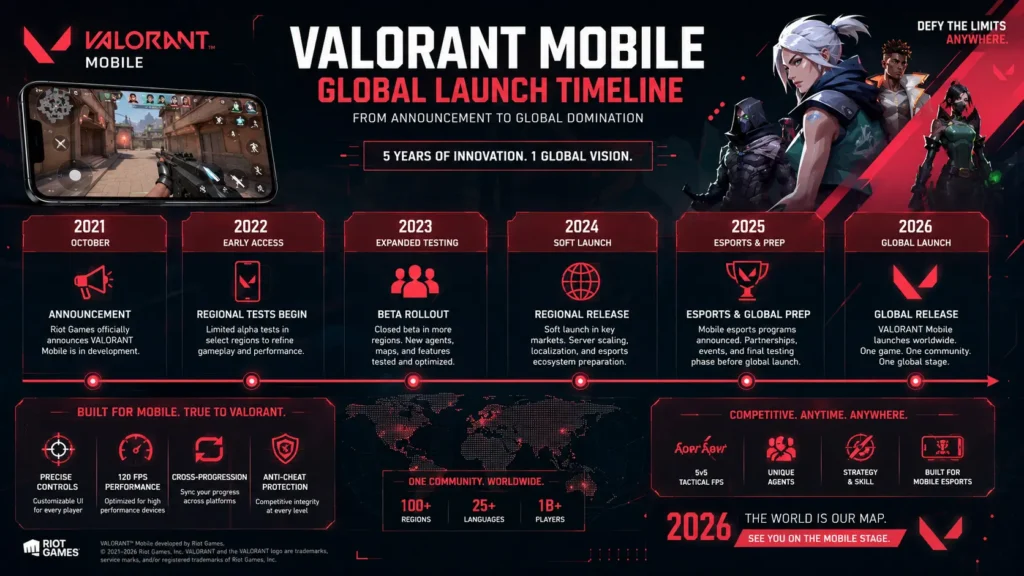
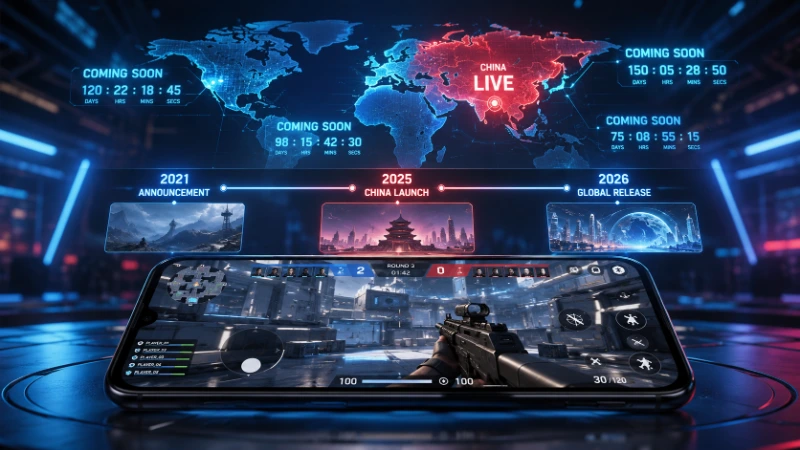
Valorant Mobile officially launched in China on August 19, 2025, under a partnership between Riot Games and Tencent’s subsidiary LightSpeed Studios — the same team behind PUBG Mobile’s 1 billion downloads. In China, the game is titled “Fearless Covenant,” and it has been a runaway success.
As of June 2026, no official global release date has been confirmed. That said, industry momentum is unmistakable. The most credible estimates from insiders and analysts point to a global beta or soft launch landing in mid-to-late 2026, with a full worldwide release following once server stability is confirmed across regions.
Here is the timeline in plain terms:
- June 2021: Riot confirms Valorant Mobile is in development
- June 2024: China’s National Press and Publication Administration approves the game under the codename “Operation Primal”
- April 21, 2025: Riot officially confirms China-first launch with LightSpeed Studios
- August 19, 2025: Valorant Mobile launches in China as “Fearless Covenant”
- December 2025: Chinese National Finals conclude, potentially opening the door for global rollout
- Mid-2026: Global beta expected, according to industry insiders and dataminers
- Late 2026: Full worldwide release if beta goes smoothly
Why the staggered approach? Riot used China as a living, large-scale technical test environment. With 50 million monthly active users generating real data about server loads, device performance, and match behavior, they have been refining infrastructure for a global audience that will be far larger. This is the Wild Rift playbook — China and Asia first, then the world.
If you are outside China right now, attempting to play via VPN and an APK download is technically possible but practically miserable. Chinese servers produce ping of around 250ms for players in North America or Europe. In a game where reaction time is measured in milliseconds, that is not a viable option.
The right move is to stay patient, register on official Riot channels the moment pre-registration opens, and use this waiting period to prepare your device and sharpen your tactical knowledge.
Is Valorant Mobile Really a Ground-Up Rebuild?
Yes — and this distinction matters more than most people realize.
When Riot ported League of Legends to mobile as Wild Rift, they rebuilt the game engine from scratch rather than adapting the PC code. Valorant Mobile follows the same philosophy. Developers confirmed early on that they were not taking the PC client and shrinking it down. They were asking a fundamentally different question: what does a competitive tactical FPS feel like when your only input device is a glass screen?
That question forced some genuinely creative solutions. Movement on PC is built on counter-strafing — the precise technique of stopping your momentum before firing to improve accuracy. On mobile, virtual joysticks cannot replicate that mechanic directly. So Riot engineered an adaptive movement system that interprets the intent behind mobile input and applies appropriate accuracy windows. It is not identical to PC. It is not supposed to be. But it is designed to feel fair within the mobile ecosystem.
Ability casting went through similar reinvention. On PC, agents like Sage or Omen use abilities that require precise cursor placement. On mobile, the interface provides enhanced visual guidance for positioning, with streamlined tap-and-confirm input patterns. Players who main controllers or area-denial agents will notice the adaptation most.
The result, based on what Chinese players have been reporting since August 2025, is a game that genuinely feels like Valorant — not a diluted imitation of it.
What Agents and Maps Are Available at Launch?
Here is what has been confirmed and what remains in flux.
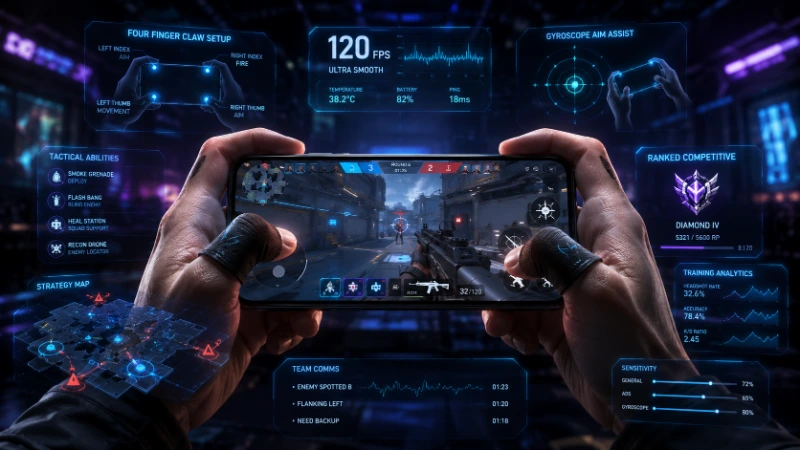
Valorant Mobile launched in China with 17 playable agents, covering the core roles that define the PC meta: Duelists, Initiators, Controllers, and Sentinels. Not every PC agent made the initial cut, and rollout of additional agents will be gradual. This mirrors how Riot manages content parity in Wild Rift — new agents arrive on mobile, but often weeks or months after their PC debut.
For maps, the mobile version launched with a mix of familiar faces and new territory. Classic maps like Bind, Haven, and Split are present. Ascent and Icebox are confirmed to arrive post-launch. More interestingly, two maps built specifically for mobile — Shipyard and Ancient Village — are part of the initial rotation. These maps were designed with mobile field-of-view constraints in mind, featuring tighter angles and shorter sightlines that suit touch-based aiming.
This is actually a smart design call. PC maps like Icebox are notoriously punishing because of their long-range sightlines and vertical elements. On mobile, where precision aiming is inherently limited compared to a mouse, having mobile-native maps with shorter engagements creates a fairer competitive environment.
Game modes at launch include the core 5v5 Spike Rush, Deathmatch for warmups, and the main competitive mode. Riot has confirmed the round structure has been adjusted — early reports from Chinese players suggest first-to-8 rounds rather than the PC standard of first-to-13, keeping matches under 20 minutes. This is exactly the kind of adaptation that mobile play demands.
What Are the System Requirements for Valorant Mobile?
This is where Valorant Mobile genuinely surprises people. Riot is not building an exclusive experience for flagship phones.
Android Minimum Requirements:
- OS: Android 5.0 or higher
- Processor: Snapdragon 450, Helio P23, or Kirin 710
- RAM: 3GB minimum
- Storage: 10–16GB free space
iOS Minimum Requirements:
- OS: iOS 12.0 or higher
- Device: iPhone 6s or newer
- RAM: 2GB minimum
- Storage: 10–16GB free space
For competitive play, higher specs are obviously recommended. Devices running Snapdragon 8 Gen 2 or Apple A15 chips will reach higher frame rates with more stable performance. But the minimum bar is deliberately accessible. Riot wants to reach players in Southeast Asia, South Asia, and Latin America — regions where mobile gaming is dominant but flagship device ownership is not.
The target for mid-range devices is a smooth 60fps experience, with 120fps available on supported hardware. That 120fps target on mobile is significant. Most mobile shooters run at 60fps as the ceiling. If Riot delivers consistent 120fps gameplay on capable devices, it changes how responsive the game feels at a fundamental level.
If you are unsure whether your current device qualifies, the game will run an automatic benchmark on first launch and set graphics presets accordingly. Do not override those presets immediately — spend a few matches at the recommended settings before pushing for higher frames.
How Does PC Cross-Play Work — Or Does It?
It does not. At least not at launch, and likely not for a long time.
Riot has been explicit about this. Cross-play between PC and mobile is not planned for the initial global launch. The reasoning is straightforward and fair: mouse-and-keyboard input has a fundamental precision advantage over touchscreen controls. In a game built on competitive integrity, mixing those input types in the same match would create systematic unfairness.
Mobile players will compete only against other mobile players. Matchmaking pools are completely separate. This is the right call. The temptation to enable cross-play for “unified community” reasons would undermine the very thing that makes Valorant worth playing — a sense that your rank reflects genuine skill, not hardware advantage.
What does carry over is your Riot account. Your Riot ID, your account history, and your broader identity in the Riot ecosystem will be consistent. Progression, however, is where things get murky. Based on what Riot did with Wild Rift, skin inventories are likely to remain separate between platforms. Your Reaver Vandal from PC probably does not automatically appear in your mobile collection. Official confirmation is still pending, but approach it with managed expectations rather than optimism.
Valorant Points (VP) will be the premium currency on mobile, consistent with the PC system. Cosmetics — weapon skins, knife skins, player cards, battle passes — will all be purchasable. Monetization is cosmetics-only. No pay-to-win mechanics exist in the PC version and none are confirmed for mobile.
How Do Touch Controls Actually Feel?
This is the question that determines whether Valorant Mobile becomes an esport or a novelty.
The core challenge is this: Valorant on PC is a game of millimeter-level precision. Flick shots, crosshair placement, and recoil control require the kind of fine motor input that a mouse provides almost effortlessly. A touchscreen cannot replicate that. What it can do is create a system where the gap between skilled and unskilled players remains meaningful — just expressed differently.
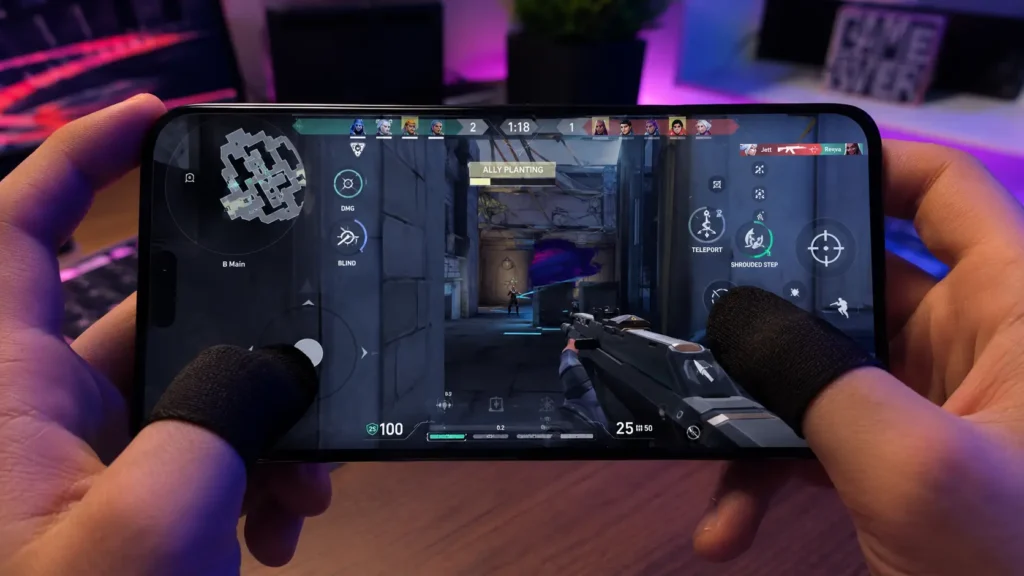
Valorant Mobile uses dual virtual joysticks as the default movement and camera scheme, similar to other mobile shooters. Left stick moves your character. Right stick controls camera angle. Fire, reload, ability buttons, and jump are mapped to the right side of the screen in customizable positions.
The customization depth here is notable. Button size, button placement, sensitivity curves, gyroscope integration — all of these can be tuned. Gyro aiming deserves specific attention. Players using devices with gyroscopes can use physical phone tilt to make fine aim adjustments, mimicking the micro-correction that a mouse provides. Competitive mobile FPS players who master gyro aiming in games like BGMI (Battlegrounds Mobile India) consistently outperform joystick-only players. Expect the same dynamic in Valorant Mobile.
One more thing worth doing before launch: optimize your device for the best possible performance. Background apps, thermal throttling, and network instability will hurt you far more on a touchscreen than on PC. Our complete guide on how to reduce lag in mobile games walks through every setting worth tweaking before your first ranked match.
The honest take: if you are a high-ranked PC player expecting to pick up mobile and immediately feel comfortable, prepare for a few weeks of adjustment. The mechanical translation is real. But if you approach mobile controls as their own discipline — not a downgrade from PC, but a different skill expression — the competitive ceiling on mobile will reward dedicated practice.
Will Valorant Mobile Have a Ranked Mode and Esports?
Yes to both — and the esports infrastructure is already ahead of most people’s expectations.
Ranked mode mirrors the PC structure with Iron, Bronze, Silver, Gold, Platinum, Diamond, Ascendant, Immortal, and Radiant tiers. Separate matchmaking pools ensure mobile ranks are not contaminated by cross-platform unfairness.
More impressively, Riot has already launched competitive esports in China. A national championship with a prize pool of CN¥3,000,000 — approximately $425,000 USD — ran shortly after the August 2025 launch. Mobile esports organizations began recruitment drives almost immediately, recognizing that Valorant Mobile’s competitive structure is more rigorous than most mobile shooters.
This is important context for global players. By the time the rest of the world gets access, there will already be an established competitive framework, existing best-practice strategies, and a proven meta. Chinese players will have a several-month head start in terms of in-game experience. For casual players, this is irrelevant. For anyone with competitive aspirations, studying Chinese tournament footage before the global launch is genuinely useful preparation.
The global esports scene for Valorant Mobile is expected to eventually mirror Riot’s VCT (Valorant Champions Tour) structure on PC, with regional leagues feeding into international competition. Riot has demonstrated it knows how to build esports ecosystems. Mobile will benefit from that institutional knowledge.
How to Pre-Register and Be Ready for the Global Launch
As of June 2026, global pre-registration is not officially open outside China (where registration was through WeChat and QQ). When Riot does open global sign-ups, the pattern based on Wild Rift and other Riot mobile launches is predictable.
Steps to be ready when the launch happens:
- Follow official channels now. The @PlayVALORANT Twitter/X account, the official Valorant website, and Riot’s mobile-specific social accounts will announce pre-registration the moment it goes live.
- Make sure your Riot account is active. Log into your existing account at playvalorant.com. If you do not have one, create it now. Your Riot ID will carry into mobile.
- Check your device against the system requirements. If you are on a mid-range Android device from 2021 or newer, you are almost certainly supported. iPhones from iPhone 6s onwards qualify.
- Clear storage space. The game will require 10–16GB. Clear it before launch day so you are not scrambling during server queues. If you need something good to play offline while freeing up space and waiting for the global launch, check out our picks for the best offline RPG mobile games in 2026 — some of them will genuinely surprise you.
- Do not trust third-party APK links. When the game launches, dozens of fake download links will circulate. The only legitimate sources are Google Play Store, Apple App Store, and Riot’s official website. Third-party APKs carry malware risk and account security risks.
- Brush up on agent kits and map callouts. The fundamental knowledge from PC transfers directly. If you know what Sage’s wall does, that knowledge is immediately useful on mobile. Time spent on that now is not wasted.
Valorant Mobile vs. Competing Mobile Shooters: Where Does It Stand?
The mobile tactical shooter space has players in it already. Call of Duty Mobile, BGMI, Free Fire, and older contenders like Critical Ops have all built communities. Here is how Valorant Mobile positions against each.
vs. Call of Duty Mobile: CoD Mobile prioritizes action-first, reaction-based gameplay. Economy management, utility usage, and ability synergies are not central to its identity. Valorant Mobile appeals to players who want those layers of strategic depth that CoD Mobile lacks.
vs. BGMI / PUBG Mobile: Battle royale structure means matches run 25–35 minutes with no guarantee of meaningful engagement. Valorant’s 5v5 format with 20-minute matches and guaranteed action each round is a fundamentally different experience for players who want consistency over randomness. Still deciding between the battle royale giants while waiting for Valorant Mobile? Our PUBG Mobile vs Free Fire 2026: The Honest Verdict breaks down exactly how those two stack up right now.
vs. Free Fire: Free Fire owns the ultra-low-end device market with aggressive optimization. Valorant Mobile targets a slightly higher device floor and a noticeably higher competitive ceiling. Different audiences with some overlap.
vs. Critical Ops: Critical Ops is probably the closest existing mobile game to Valorant’s PC feel — no abilities, just tactical gunplay. Valorant Mobile adds the entire agent ability system on top, making it deeper but also more demanding to master.
The honest competitive advantage Valorant Mobile has over all of them is brand weight and design integrity. Riot spent two years building this from scratch rather than rushing a port. That intentionality shows in what Chinese players have reported experiencing. If the global version delivers the same quality, Valorant Mobile does not just compete in the mobile shooter space — it leads it.
Frequently Asked Questions About Valorant Mobile
Is Valorant Mobile available globally right now? No. As of June 2026, it is only available in China under the title “Fearless Covenant.” A global beta is widely expected in mid-to-late 2026, with a full release following.
Will Valorant Mobile be free to play? Yes. Like the PC version, it is free to download and play. Revenue comes from optional cosmetic purchases — weapon skins, player cards, and battle passes. No pay-to-win elements are present.
Can I use my PC account on Valorant Mobile? Your Riot ID and account will carry over. Skin inventory may remain separate from your PC collection, similar to how Wild Rift handled League of Legends progression. Confirm this with official announcements when global launch arrives.
Will Valorant Mobile run on my phone? If your Android device has 3GB RAM and runs Android 5.0 or higher, or if you have an iPhone 6s or newer running iOS 12+, you meet the minimum requirements. Mid-range devices from 2020 onwards will generally have a smooth experience.
Is there cross-play between PC and mobile? No. Riot has confirmed separate matchmaking pools for PC and mobile to maintain competitive fairness. Mouse-and-keyboard players will not appear in mobile matchmaking.
How many agents will be available at launch? The Chinese launch had 17 agents. Global launch content may vary, but expect a similar number with gradual additions post-launch.
Will Valorant Mobile have a ranked competitive mode? Yes. The ranked system mirrors PC Valorant with the same tier structure from Iron to Radiant. Mobile ranks are separate from PC ranks.
Can I download Valorant Mobile via APK right now? Technically yes, but it requires a Chinese WeChat or QQ account to log in and produces unplayable ping of around 250ms outside Asia. It is not a viable option, and third-party APK sources carry security risks. Wait for the official global launch.
What to Expect When the Global Launch Finally Hits
Here is a realistic picture of launch week, based on how Riot has handled previous major releases.
Servers will struggle initially. Valorant PC had server issues on launch day in June 2020 despite extensive preparation. Wild Rift had similar friction. Plan for queues and disconnects in the first 48 hours. This is not a failure of the product — it is physics.
The first week will define the early meta. Chinese players will have formed strategies over months of competitive play. Expect those strategies to flood global content channels immediately. The first week is your crash course.
Early-adopter ranked seasons will be chaotic. Matchmaking will be figuring out skill distribution from scratch. This is actually the best time to rank aggressively, because the system has not yet accurately sorted player skill levels. Players who have internalized PC Valorant strategy will have a significant advantage in early ranked seasons.
Cosmetic bundles will launch alongside the game. Riot typically releases a launch bundle with exclusive items available only during the first few weeks. If you plan to spend on cosmetics, the launch window usually offers items that disappear permanently.
The biggest prediction: Valorant Mobile will not just be another mobile shooter. If Riot delivers on the promise of genuine competitive depth on a touchscreen, it has the potential to create a mobile esports ecosystem as significant as what PUBG Mobile built — but with better game design underneath it.
Final Thoughts: Should You Be Excited?
Honestly — yes. But calibrated excitement is the right kind.
Valorant Mobile is not going to feel identical to PC on day one. The control gap is real and it takes time to close. The agent roster is smaller. Some maps you love might not be there immediately. Cross-progression for skins is uncertain. These are legitimate limitations worth acknowledging.
What is also real: Riot has demonstrated with Wild Rift that they can maintain a mobile game with the same quality and care as their PC flagship. The Chinese launch with 50 million monthly users in a few months is not a soft success — it is a validation signal that the product is genuinely good.
The global wait has been long. Over four years from announcement to a worldwide launch. That timeline is frustrating, but it produced something that Chinese players are genuinely invested in rather than merely trying before returning to other games.
When the global beta opens, jump in. Form your own opinion. But go in knowing that this is a serious competitive product built by a team that has thought deeply about what Valorant means — and what it needs to be on mobile to honor that identity.
What is your biggest question about Valorant Mobile that nobody has answered yet? Drop it in the comments — I read every one and respond to the best questions directly.